Multiple Choice
Identify the
choice that best completes the statement or answers the question.
|
|
|
1.
|
If photosynthesizing green algae are provided with
 synthesized with heavy oxygen ( synthesized with heavy oxygen ( ), later analysis will show that all but one of the following compounds produced by the
algae contain the ), later analysis will show that all but one of the following compounds produced by the
algae contain the  label. That one is label. That one is
a. | PGA. | b. | PGAL. | c. | glucose. | d. | RuBP. | e. |  . . |
|
|
|
2.
|
Which of the following are products of the light
reactions of photosynthesis that are utilized in the Calvin cycle?
a. |  and
glucose and
glucose | b. |  and and  | c. | ADP,  , and NADP , and NADP | d. | electrons and H | e. | ATP and NADPH |
|
|
|
3.
|
What are the products of the light reactions that
are subsequently used by the Calvin cycle?
a. | oxygen and carbon dioxide | b. | carbon dioxide and RuBP | c. | water and
carbon | d. | electrons and photons | e. | ATP and NADPH |
|
|
|
4.
|
Where does the Calvin cycle take
place?
a. | stroma of the chloroplast | b. | thylakoid membrane | c. | cytoplasm
surrounding the chloroplast | d. | chlorophyll
molecule | e. | outer membrane of the
chloroplast |
|
|
|
5.
|
In any ecosystem, terrestrial or aquatic, what
group(s) is (are) always necessary?
a. | autotrophs and heterotrophs | b. | producers and primary consumers | c. | photosynthesizers | d. | autotrophs | e. | green
plants |
|
|
|
6.
|
In autotrophic bacteria, where are the enzymes
located that can carry on organic synthesis?
a. | chloroplast membranes | b. | nuclear membranes | c. | free in the
cytosol | d. | along the outer edge of the
nucleoid | e. | along the inner surface of the plasma
membrane |
|
|
|
7.
|
When oxygen is released as a result of
photosynthesis, it is a by-product of which of the following?
a. | reducing NADP | b. | splitting the water molecules | c. | chemiosmosis | d. | the electron
transfer system of photosystem I | e. | the electron
transfer system of photosystem II |
|
|
|
8.
|
A plant has a unique photosynthetic pigment. The
leaves of this plant appear to be reddish yellow. What wavelengths of visible light are being
absorbed by this pigment?
a. | red and yellow | b. | blue and violet | c. | green and
yellow | d. | blue, green, and red | e. | green, blue, and yellow |
|
|
|
Use the following information to answer the
questions below.
Theodor W. Engelmann illuminated a filament of algae with light that
passed through a prism, thus exposing different segments of algae to different wavelengths of light.
He added aerobic bacteria and then noted in which areas the bacteria congregated. He noted that the
largest groups were found in the areas illuminated by the red and blue light.
|
|
|
9.
|
What did Engelmann conclude about the congregation
of bacteria in the red and blue areas?
a. | Bacteria released excess carbon dioxide in these
areas. | b. | Bacteria congregated in these areas due to an increase
in the temperature of the red and blue light. | c. | Bacteria
congregated in these areas because these areas had the most oxygen being
released. | d. | Bacteria are attracted to red and blue light and thus
these wavelengths are more reactive than other wavelengths. | e. | Bacteria congregated in these areas due to an increase in the temperature
caused by an increase in photosynthesis. |
|
|
|
10.
|
An outcome of this experiment was to help
determine
a. | the relationship between heterotrophic and autotrophic
organisms. | b. | the relationship
between wavelengths of light and the rate of aerobic respiration. | c. | the relationship between wavelengths of light and the amount of heat
released. | d. | the relationship between wavelengths of light and the
oxygen released during photosynthesis. | e. | the relationship
between the concentration of carbon dioxide and the rate of
photosynthesis. |
|
|
|
11.
|
If you ran the same experiment without passing
light through a prism, what would you predict?
a. | There would be no difference in
results. | b. | The bacteria would be relatively evenly distributed
along the algal filaments. | c. | The number of
bacteria present would decrease due to an increase in the carbon dioxide
concentration. | d. | The number of
bacteria present would increase due to an increase in the carbon dioxide
concentration. | e. | The number of
bacteria would decrease due to a decrease in the temperature of the
water. |
|
|
|
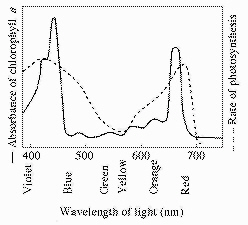
Figure
10.1
|
|
|
12.
|
Figure 10.1 shows the absorption spectrum for
chlorophyll a and the action spectrum for photosynthesis. Why are they
different?
a. | Green and yellow wavelengths inhibit the absorption of
red and blue wavelengths. | b. | Bright sunlight
destroys photosynthetic pigments. | c. | Oxygen given off
during photosynthesis interferes with the absorption of light. | d. | Other pigments absorb light in addition to chlorophyll
a. | e. | Aerobic bacteria take up oxygen which changes the
measurement of the rate of photosynthesis. |
|
|
|
13.
|
What wavelength of light in the figure is
most effective in driving photosynthesis?
a. | 420 mm | b. | 475 mm | c. | 575
mm | d. | 625 mm | e. | 730 mm |
|
|
|
14.
|
Compared with the lines for chlorophyll a in
the figure, where would you expect to find the lines to differ for chlorophyll
b?
a. | The absorption spectrum line would be lowest for
chlorophyll b somewhat to the right of that for chlorophyll a
(500—600). | b. | The rate of
photosynthesis line for chlorophyll b would be lowest from 600—700
nm. | c. | The lines for the two types of chlorophyll would be
almost completely opposite. | d. | The lines for the
two types of chlorophyll would be almost completely identical. | e. | The peaks of the line for absorbance of b would be shifted to the left,
and for rate of photosynthesis would be shifted to the right. |
|
|
|
15.
|
In the thylakoid membranes, what is the main role
of the antenna pigment molecules?
a. | split water and release oxygen to the reaction-center
chlorophyll | b. | harvest photons
and transfer light energy to the reaction-center chlorophyll | c. | synthesize ATP from ADP and Pi | d. | transfer electrons to ferredoxin and then NADPH | e. | concentrate photons within the stroma |
|
|
|
16.
|
The reaction-center chlorophyll of photosystem I is
known as P700 because
a. | there are 700 chlorophyll molecules in the
center. | b. | this pigment is best at absorbing light with a
wavelength of 700 nm. | c. | there are 700
photosystem I components to each chloroplast. | d. | it absorbs 700
photons per microsecond. | e. | the plastoquinone
reflects light with a wavelength of 700 nm. |
|
|
|
17.
|
Which of the events listed below occur in the light
reactions of photosynthesis?
a. | NADP is produced. | b. |  is reduced to NADP is reduced to NADP . . | c. | carbon dioxide is
incorporated into PGA. | d. | ATP is
phosphorylated to yield ADP. | e. | light is absorbed
and funneled to reaction-center chlorophyll a. |
|
|
|
18.
|
Which statement describes the functioning of
photosystem II?
a. | Light energy excites electrons in the electron transport
chain in a photosynthetic unit. | b. | The excitation is
passed along to a molecule of P700 chlorophyll in the photosynthetic unit. | c. | The P680 chlorophyll donates a pair of protons to NADPH, which is thus
converted to NADP . . | d. | The electron vacancies in P680 are filled by electrons derived from
water. | e. | The splitting of water yields molecular carbon dioxide
as a by-product. |
|
|
|
19.
|
Which of the following are directly associated with
photosystem I?
a. | harvesting of light energy by
ATP | b. | receiving electrons from
plastocyanin | c. | P680
reaction-center chlorophyll | d. | extraction of
hydrogen electrons from the splitting of water | e. | passing electrons
to plastoquinone |
|
|
|
20.
|
Some photosynthetic organisms contain chloroplasts
that lack photosystem II, yet are able to survive. The best way to detect the lack of photosystem II
in these organisms would be
a. | to determine if they have thylakoids in the
chloroplasts. | b. | to test for
liberation of  in the light. in the light. | c. | to test for  fixation in the
dark. fixation in the
dark. | d. | to do experiments to generate an action
spectrum. | e. | to test for production of either sucrose or
starch. |
|
|
|
21.
|
What are the products of linear
photophosphorylation?
a. | heat and fluorescence | b. | ATP and P700 | c. | ATP and
NADPH | d. | ADP and NADP | e. | P700 and P680 |
|
|
|
22.
|
As a research scientist, you measure the amount of
ATP and NADPH consumed by the Calvin cycle in 1 hour. You find 30,000 molecules of ATP consumed, but
only 20,000 molecules of NADPH. Where did the extra ATP molecules come from?
a. | photosystem II | b. | photosystem I | c. | cyclic electron
flow | d. | linear electron flow | e. | chlorophyll |
|
|
|
23.
|
Assume a thylakoid is somehow punctured so that the
interior of the thylakoid is no longer separated from the stroma. This damage will have the most
direct effect on which of the following processes?
a. | the splitting of water | b. | the absorption of light energy by chlorophyll | c. | the flow of electrons from photosystem II to photosystem
I | d. | the synthesis of ATP | e. | the reduction of NADP |
|
|
|
24.
|
What does the chemiosmotic process in chloroplasts
involve?
a. | establishment of a proton
gradient | b. | diffusion of electrons through the thylakoid
membrane | c. | reduction of water to produce ATP
energy | d. | movement of water by osmosis into the thylakoid space
from the stroma | e. | formation of
glucose, using carbon dioxide, NADPH, and ATP |
|
|
|
25.
|
Suppose the interior of the thylakoids of isolated
chloroplasts were made acidic and then transferred in the dark to a pH-8 solution. What would be
likely to happen?
a. | The isolated chloroplasts will make
ATP. | b. | The Calvin cycle will be
activated. | c. | Cyclic
photophosphorylation will occur. | d. | Only A and B will
occur. | e. | A, B, and C will
occur. |
|
|
|
26.
|
In a plant cell, where are the ATP synthase
complexes located?
a. | thylakoid membrane | b. | plasma membrane | c. | inner
mitochondrial membrane | d. | A and
C | e. | A, B, and C |
|
|
|
27.
|
In mitochondria, chemiosmosis translocates protons
from the matrix into the intermembrane space, whereas in chloroplasts, chemiosmosis translocates
protons from
a. | the stroma to the photosystem
II. | b. | the matrix to the stroma. | c. | the stroma to the thylakoid space. | d. | the intermembrane space to the matrix. | e. | ATP synthase to NADP reductase.
 |
|
|
|
28.
|
Which of the following statements best
describes the relationship between photosynthesis and respiration?
a. | Respiration is the reversal of the biochemical pathways
of photosynthesis. | b. | Photosynthesis
stores energy in complex organic molecules, while respiration releases it. | c. | Photosynthesis occurs only in plants and respiration occurs only in
animals. | d. | ATP molecules are produced in photosynthesis and used up
in respiration. | e. | Respiration is
anabolic and photosynthesis is catabolic. |
|
|
|
29.
|
Where are the molecules of the electron transport
chain found in plant cells?
a. | thylakoid membranes of
chloroplasts | b. | stroma of
chloroplasts | c. | outer membrane of
mitochondria | d. | matrix of
mitochondria | e. | cytoplasm |
|
|
|
30.
|
Synthesis of ATP by the chemiosmotic mechanism
occurs during
a. | photosynthesis. | b. | respiration. | c. | both
photosynthesis and respiration. | d. | neither
photosynthesis nor respiration. | e. | photorespiration. |
|
|
|
31.
|
Reduction of oxygen which forms water occurs
during
a. | photosynthesis. | b. | respiration. | c. | both
photosynthesis and respiration. | d. | neither
photosynthesis nor respiration. | e. | photorespiration. |
|
|
|
32.
|
Reduction of NADP occurs
during occurs
during
a. | photosynthesis. | b. | respiration. | c. | both
photosynthesis and respiration. | d. | neither
photosynthesis nor respiration. | e. | photorespiration. |
|
|
|
33.
|
The splitting of carbon dioxide to form oxygen gas
and carbon compounds occurs during
a. | photosynthesis. | b. | respiration. | c. | both
photosynthesis and respiration. | d. | neither
photosynthesis nor respiration. | e. | photorespiration. |
|
|
|
34.
|
Generation of proton gradients across membranes
occurs during
a. | photosynthesis. | b. | respiration. | c. | both
photosynthesis and respiration. | d. | neither
photosynthesis nor respiration. | e. | photorespiration. |
|
|
|
35.
|
What is the relationship between wavelength of
light and the quantity of energy per photon?
a. | They have a direct, linear
relationship. | b. | They are inversely
related. | c. | They are logarithmically
related. | d. | They are separate phenomena. | e. | They are only related in certain parts of the
spectrum. |
|
|
|
36.
|
In a protein complex for the light reaction (a
reaction center), energy is transferred from pigment molecule to pigment molecule, to a special
chlorophyll a molecule, and eventually to the primary electron acceptor. Why does this
occur?
a. | The action spectrum of that molecule is such that it is
different from other molecules of chlorophyll. | b. | The potential
energy of the electron has to go back to the ground state. | c. | The molecular environment lets it boost an electron to a higher energy level
and also to transfer the electron to another molecule. | d. | Each pigment molecule has to be able to act independently to excite
electrons. | e. | These chlorophyll
a molecules are associated with higher concentrations of ATP. |
|
|
|
37.
|
P680 is said to be the strongest
biological oxidizing agent. Why? is said to be the strongest
biological oxidizing agent. Why?
a. | It is the receptor for the most excited electron in
either photosystem. | b. | It is the molecule
that transfers electrons to plastoquinone (Pq) of the electron transfer
system. | c. | NADP reductase will then catalyze the shift of the
electron from Fd to NADP to reduce it to
NADPH. to reduce it to
NADPH. | d. | This molecule results from the transfer of an electron
to the primary electron acceptor of photosystem II and strongly attracts another
electron. | e. | This molecule is found far more frequently among
bacteria as well as in plants and plantlike Protists. |
|
|
|
38.
|
Some photosynthetic bacteria (e.g., purple sulfur
bacteria) have photosystem I but not II, while others (e.g. cyanobacteria) have both PSI and PSII.
Which of the following might this observation imply?
a. | Photosystem II must have been selected against in some
species. | b. | Photosystem I must be more
ancestral. | c. | Photosystem II may
have evolved to be more photoprotective. | d. | Cyclic flow must
be more primitive than linear flow of electrons. | e. | Cyclic flow must be the most necessary of the two
processes. |
|
|
|
39.
|
Cyclic electron flow may be photoprotective
(protective to light-induced damage). Which of the following experiments could provide information on
this phenomenon?
a. | using mutated organisms that can grow but that cannot
carry out cyclic flow of electrons and compare their abilities to photosynthesize in different light
intensities | b. | using plants that
can carry out both linear and cyclic electron flow, or only one or another of thee processes, and
measuring their light absorbance | c. | using bacteria
that have only cyclic flow and look for their frequency of mutation damage | d. | using bacteria with only cyclic flow and measuring the number and types of
photosynthetic pigments they have in their membranes | e. | using plants with only photosystem I operative and measure how much damage
occurs at different wavelengths. |
|
|
|
40.
|
Carotenoids are often found in foods that are
considered to have antioxidant properties in human nutrition. What related function do they have in
plants?
a. | They serve as accessory
pigments. | b. | They dissipate excessive light
energy. | c. | They cover the sensitive chromosomes of the
plant. | d. | They reflect orange light. | e. | They take up toxins from the water. |
|
|
|
41.
|
In thylakoids, protons travel through ATP synthase
from the stroma to the thylakoid space. Therefore the catalytic "knobs" of ATP synthase
would be located
a. | on the side facing the thylakoid
space. | b. | on the ATP molecules
themselves. | c. | on the pigment
molecules of PSI and PSII. | d. | on the stroma side
of the membrane. | e. | built into the
center of the thylkoid stack (granum). |
|
|
|
42.
|
Which of the following statements best represents
the relationships between the light reactions and the Calvin cycle?
a. | The light reactions provide ATP and NADPH to the Calvin
cycle, and the cycle returns ADP,  , and NADP , and NADP to the light
reactions. to the light
reactions. | b. | The light
reactions provide ATP and NADPH to the carbon fixation step of the Calvin cycle, and the cycle
provides water and electrons to the light reactions. | c. | The light reactions supply the Calvin cycle with  to produce
sugars, and the Calvin cycle supplies the light reactions with sugars to produce
ATP. to produce
sugars, and the Calvin cycle supplies the light reactions with sugars to produce
ATP. | d. | The light reactions provide the Calvin cycle with oxygen
for electron flow, and the Calvin cycle provides the light reactions with water to
split. | e. | There is no relationship between the light reactions and
the Calvin cycle. |
|
|
|
43.
|
Where do the enzymatic reactions of the Calvin
cycle take place?
a. | stroma of the chloroplast | b. | thylakoid membranes | c. | outer membrane of
the chloroplast | d. | electron transport
chain | e. | thylakoid space |
|
|
|
44.
|
What is the primary function of the Calvin
cycle?
a. | use ATP to release carbon
dioxide | b. | use NADPH to release carbon
dioxide | c. | split water and release
oxygen | d. | transport RuBP out of the
chloroplast | e. | synthesize simple
sugars from carbon dioxide |
|
|
|
For the following questions, compare the light
reactions with the Calvin cycle of photosynthesis in plants.
|
|
|
45.
|
Produces molecular oxygen ( ) )
a. | light reactions alone | b. | the Calvin cycle alone | c. | both the light
reactions and the Calvin cycle | d. | neither the light
reactions nor the Calvin cycle | e. | occurs in the
chloroplast but is not part of photosynthesis |
|
|
|
46.
|
Requires ATP
a. | light reactions alone | b. | the Calvin cycle alone | c. | both the light
reactions and the Calvin cycle | d. | neither the light
reactions nor the Calvin cycle | e. | occurs in the
chloroplast but is not part of photosynthesis |
|
|
|
47.
|
Produces NADH
a. | light reactions alone | b. | the Calvin cycle alone | c. | both the light
reactions and the Calvin cycle | d. | neither the light
reactions nor the Calvin cycle | e. | occurs in the
chloroplast but is not part of photosynthesis |
|
|
|
48.
|
Produces NADPH
a. | light reactions alone | b. | the Calvin cycle alone | c. | both the light
reactions and the Calvin cycle | d. | neither the light
reactions nor the Calvin cycle | e. | occurs in the
chloroplast but is not part of photosynthesis |
|
|
|
49.
|
Produces three-carbon sugars
a. | light reactions alone | b. | the Calvin cycle alone | c. | both the light
reactions and the Calvin cycle | d. | neither the light
reactions nor the Calvin cycle | e. | occurs in the
chloroplast but is not part of photosynthesis |
|
|
|
50.
|
Requires 
a. | light reactions alone | b. | the Calvin cycle alone | c. | both the light
reactions and the Calvin cycle | d. | neither the light
reactions nor the Calvin cycle | e. | occurs in the
chloroplast but is not part of photosynthesis |
|
|
|
51.
|
Requires glucose
a. | light reactions alone | b. | the Calvin cycle alone | c. | both the light
reactions and the Calvin cycle | d. | neither the light
reactions nor the Calvin cycle | e. | occurs in the
chloroplast but is not part of photosynthesis |
|
|
|
52.
|
The sugar that results from three "turns"
of the Calvin cycle is glyceraldehyde-3-phosphate (G3P). Which of the following is a consequence of
this?
a. | Formation of a molecule of glucose would require 9
"turns." | b. | G3P more readily
forms sucrose and other disaccharides than it does monosaccharides. | c. | Some plants would not taste sweet to us. | d. | The formation of starch in plants involves assembling many G3P molecules, with
or without further rearrangements. | e. | G3P is easier for
a plant to store. |
|
|
|
53.
|
In the process of carbon fixation, RuBP attaches a
 to produce a 6 carbon molecule, which is then
split in two. After phosphorylation and reduction, what more needs to happen in the Calvin
cycle? to produce a 6 carbon molecule, which is then
split in two. After phosphorylation and reduction, what more needs to happen in the Calvin
cycle?
a. | addition of a pair of electrons from
NADPH | b. | inactivation of RuBP carboxylase
enzyme | c. | regeneration of ATP from ADP | d. | regeneration of RuBP | e. | a gain of
NADPH |
|
|
|
Use the following figure and the stages labeled
A, B, C, D, and E to answer the following questions.
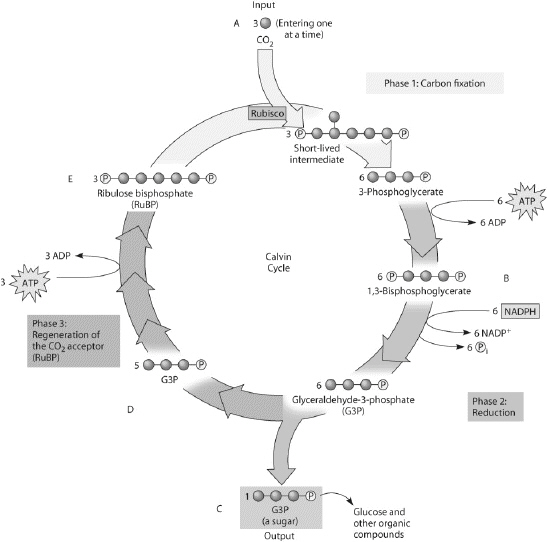
Figure 10.2
|
|
|
54.
|
If ATP used by this plant is labeled with
radioactive phosphorus, in which molecules will the radioactivity be measurable after one
"turn" of the cycle?
a. | in B only | b. | in B and C only | c. | in B, C, and D
only | d. | in B and E only | e. | in B, C, D, and E |
|
|
|
55.
|
If the carbon atom of the incoming  molecule is labeled with a radioactive isotope of carbon, where will the radioactivity be measurable
after one cycle?
molecule is labeled with a radioactive isotope of carbon, where will the radioactivity be measurable
after one cycle?
a. | in C only | b. | in B, D, and E only | c. | in C, D, and
E | d. | in A, B, and C | e. | in B and C |
|
|
|
56.
|
Which molecule(s) of the Calvin cycle is/are most
like molecules found in glycolysis?
a. | A, B, C, and E | b. | B, C, and E | c. | A
only | d. | C and D only | e. | E only |
|
|
|
57.
|
In metabolic processes of cell respiration and
photosynthesis, prosthetic groups such as heme and iron-sulfur complexes are encountered. What do
they do?
a. | donate electrons | b. | act as reducing agents | c. | act as oxidizing
agents | d. | transport protons within the mitochondria and
chloroplasts | e. | both oxidize and
reduce during electron transport |
|
|
|
58.
|
The pH of the inner thylakoid space has been
measured, as have the pH of the stroma and of the cytosol of a particular plant cell. Which, if any,
relationship would you expect to find?
a. | The pH within the thylakoid is less than that of the
stroma. | b. | The pH of the stroma is higher than that of the other
two measurements. | c. | The pH of the
stroma is higher than that of the thylakoid space but lower than that of the
cytosol. | d. | The pH of the thylakoid space is higher than that
anywhere else in the cell. | e. | There is no
consistent relationship. |
|
|
|
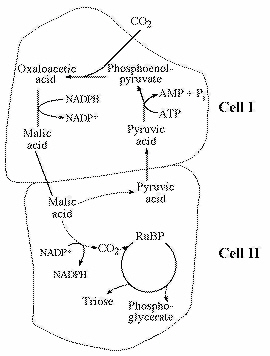
Figure
10.3
|
|
|
59.
|
Which of the following statements is true
concerning Figure 10.3?
a. | It represents cell processes involved in  photosynthesis.
 | b. | It represents the
type of cell structures found in CAM plants. | c. | It represents an
adaptation that maximizes photorespiration. | d. | It represents a
 photosynthetic
system. photosynthetic
system. | e. | It represents a relationship between plant cells that
photosynthesize and those that cannot. |
|
|
|
60.
|
Referring to Figure 10.3, oxygen would inhibit the
 fixation reactions in fixation reactions in
a. | cell I only. | b. | cell II only. | c. | neither cell I nor
cell II. | d. | both cell I and cell II. | e. | cell I during the night and cell II during the
day. |
|
|
|
61.
|
In which cell would you expect
photorespiration?
a. | Cell I | b. | Cell II | c. | Cell I at
night | d. | Cell II at night | e. | neither Cell I nor Cell II |
|
|
|
62.
|
In an experiment studying photosynthesis performed
during the day, you provide a plant with radioactive carbon ( ) dioxide as
a metabolic tracer. The ) dioxide as
a metabolic tracer. The  is incorporated first into oxaloacetate. The
plant is best characterized as a is incorporated first into oxaloacetate. The
plant is best characterized as a
a. |  plant.
 | b. |  plant.
 | c. | CAM plant. | d. | heterotroph. | e. | chemoautotroph. |
|
|
|
63.
|
Why are  plants able to
photosynthesize with no apparent photorespiration? plants able to
photosynthesize with no apparent photorespiration?
a. | They do not participate in the Calvin
cycle. | b. | They use PEP carboxylase to initially fix  . . | c. | They are adapted
to cold, wet climates. | d. | They conserve
water more efficiently. | e. | They exclude
oxygen from their tissues. |
|
|
|
64.
|
CAM plants keep stomata closed in daytime, thus
reducing loss of water. They can do this because they
a. | fix  into organic acids during
the night. into organic acids during
the night. | b. | fix  into sugars in the bundle-sheath cells. into sugars in the bundle-sheath cells. | c. | fix  into pyruvate in the mesophyll
cells. into pyruvate in the mesophyll
cells. | d. | use the enzyme phosphofructokinase, which outcompetes
rubisco for  . . | e. | use photosystems I and II at night. |
|
|
|
65.
|
Photorespiration lowers the efficiency of
photosynthesis by preventing the formation of
a. | carbon dioxide molecules. | b. | 3-phosphoglycerate molecules | c. | ATP molecules. | d. | ribulose
bisphosphate molecules. | e. | RuBP carboxylase
molecules. |
|
|
|
66.
|
The alternative pathways of photosynthesis using
the  or CAM systems are said to be compromises.
Why? or CAM systems are said to be compromises.
Why?
a. | Each one minimizes both water loss and rate of
photosynthesis. | b. |  compromises on water loss and CAM compromises on photorespiration.
 | c. | Each one both minimizes photorespiration and optimizes the Calvin
cycle. | d. | CAM plants allow more water loss, while  plants allow less
  into the plant. into the plant. | e. |  plants allow less water loss but Cam plants
but allow more water loss. plants allow less water loss but Cam plants
but allow more water loss. |
|
|
|
67.
|
If plant gene alterations cause the plants to be
deficient in photorespiration, what would most probably occur?
a. | Cells would carry on more
photosynthesis. | b. | Cells would carry
on the Calvin cycle at a much slower rate. | c. | Less ATP would be
generated. | d. | There would be
more light-induced damage to the cells. | e. | More sugars would
be produced. |
|
|
|
68.
|
The light reactions of photosynthesis supply the
Calvin cycle with
a. | light energy. | b. |  and ATP. and ATP. | c. |  and NADPH. and NADPH. | d. | ATP and NADPH. | e. | sugar and  . . |
|
|
|
69.
|
Which of the following sequences correctly
represents the flow of electrons during photosynthesis?
a. | NADPH ®  ®
®  | b. |  ® NADPH ® Calvin cycle ® NADPH ® Calvin cycle | c. | NADPH ® chlorophyll ® Calvin
cycle | d. |  ® photosystem I ® photosystem
II ® photosystem I ® photosystem
II | e. | NADPH ® electron
transport chain ®  |
|
|
|
70.
|
In mechanism, photophosphorylation is most
similar to
a. | substrate-level phosphorylation in
glycolysis. | b. | oxidative
phosphorylation in cellular respiration. | c. | the Calvin
cycle. | d. | carbon fixation. | e. | reduction of NADP . . |
|
|
|
71.
|
How is photosynthesis similar in  and CAM plants?
a. | In both cases, only photosystem I is
used. | b. | Both types of plants make sugar without the Calvin
cycle. | c. | In both cases, rubisco is not used to fix carbon
initially. | d. | Both types of
plants make most of their sugar in the dark. | e. | In both cases,
thylakoids are not involved in photosynthesis. |
|
|
|
72.
|
Which process is most directly driven by light
energy?
a. | creation of a pH gradient by pumping protons across the
thylakoid membrane | b. | carbon fixation in
the stroma | c. | reduction of
NADP molecules molecules | d. | removal of electrons from chlorophyll molecules | e. | ATP synthesis |
|
|
|
73.
|
Which of the following statements is a correct
distinction between autotrophs and heterotrophs?
a. | Only heterotrophs require chemical compounds from the
environment. | b. | Cellular
respiration is unique to heterotrophs. | c. | Only heterotrophs
have mitochondria. | d. | Autotrophs, but
not heterotrophs, can nourish themselves beginning with  and other nutrients that
are inorganic. and other nutrients that
are inorganic. | e. | Only heterotrophs
require oxygen. |
|
|
|
74.
|
Which of the following does not occur during
the Calvin cycle?
a. | carbon fixation | b. | oxidation of NADPH | c. | release of
oxygen | d. | regeneration of the  acceptor
 | e. | consumption of
ATP |
|