Multiple Choice
Identify the
choice that best completes the statement or answers the question.
|
|
|
1.
|
The molecule that functions as the reducing agent
(electron donor) in a redox or oxidation-reduction reaction
a. | gains electrons and gains
energy. | b. | loses electrons and loses
energy. | c. | gains electrons and loses
energy. | d. | loses electrons and gains
energy. | e. | neither gains nor loses electrons, but gains or loses
energy. |
|
|
|
2.
|
Why does the oxidation of organic compounds by
molecular oxygen to produce  and water release free energy? and water release free energy?
a. | The covalent bonds in organic molecules are higher
energy bonds than those in water and carbon dioxide. | b. | Electrons are being moved from atoms that have a lower affinity for electrons
(such as C) to atoms with a higher affinity for electrons (such as O). | c. | The oxidation of organic compounds can be used to make
ATP. | d. | The electrons have a higher potential energy when
associated with water and  than they do in organic
compounds. than they do in organic
compounds. | e. | The covalent bond
in  is unstable and easily broken by electrons
from organic molecules. is unstable and easily broken by electrons
from organic molecules. |
|
|
|
3.
|
Which of the following statements describes the
results of this reaction?

|
|
|
4.
|
Where does glycolysis takes place?
a. | mitochondrial matrix | b. | mitochondrial outer membrane | c. | mitochondrial inner membrane | d. | mitochondrial intermembrane space | e. | cytosol |
|
|
|
5.
|
The ATP made during glycolysis is generated
by
a. | substrate-level
phosphorylation. | b. | electron
transport. | c. | photophosphorylation. | d. | chemiosmosis. | e. | oxidation of NADH
to NAD . . |
|
|
|
6.
|
The oxygen consumed during cellular respiration is
involved directly in which process or event?
a. | glycolysis | b. | accepting electrons at the end of the electron transport
chain | c. | the citric acid cycle | d. | the oxidation of pyruvate to acetyl CoA | e. | the phosphorylation of ADP to form ATP |
|
|
|
7.
|
Which process in eukaryotic cells will proceed
normally whether oxygen (O2) is present or absent?
a. | electron transport | b. | glycolysis | c. | the citric acid
cycle | d. | oxidative phosphorylation | e. | chemiosmosis |
|
|
|
8.
|
An electron loses potential energy when
it
a. | shifts to a less electronegative
atom. | b. | shifts to a more electronegative
atom. | c. | increases its kinetic energy. | d. | increases its activity as an oxidizing agent. | e. | attaches itself to NAD . . |
|
|
|
9.
|
Why are carbohydrates and fats considered high
energy foods?
a. | They have a lot of oxygen
atoms. | b. | They have no nitrogen in their
makeup. | c. | They can have very long carbon
skeletons. | d. | They have a lot of
electrons associated with hydrogen. | e. | They are easily
reduced. |
|
|
|
10.
|
Substrate-level phosphorylation accounts for
approximately what percentage of the ATP formed during glycolysis?
|
|
|
11.
|
During glycolysis, when glucose is catabolized to
pyruvate, most of the energy of glucose is
a. | transferred to ADP, forming
ATP. | b. | transferred directly to ATP. | c. | retained in the pyruvate. | d. | stored in the NADH produced. | e. | used to phosphorylate fructose to form
fructose-6-phosphate. |
|
|
|
12.
|
In addition to ATP, what are the end products of
glycolysis?
a. |  and and  | b. |  and pyruvate
 | c. | NADH and
pyruvate | d. |  and
NADH and
NADH | e. |  , ,  ,
and citrate ,
and citrate |
|
|
|
13.
|
Starting with one molecule of glucose, the
"net" products of glycolysis are
a. | 2 NAD , 2 H , 2 H ,
2 pyruvate, 2 ATP, and 2 ,
2 pyruvate, 2 ATP, and 2  . . | b. | 2 NADH, 2 H , 2 pyruvate, 2 ATP, and 2 , 2 pyruvate, 2 ATP, and 2  . . | c. | 2  ,
2 pyruvate, 4 ATP, and 2 ,
2 pyruvate, 4 ATP, and 2  . . | d. | 6  , 6 , 6  , 2 ATP, and 2
pyruvate. , 2 ATP, and 2
pyruvate. | e. | 6  , 6 , 6  , 36 ATP, and 2 citrate. , 36 ATP, and 2 citrate. |
|
|
|
14.
|
In glycolysis, for each molecule of glucose
oxidized to pyruvate
a. | 2 molecules of ATP are used and 2 molecules of ATP are
produced. | b. | 2 molecules of ATP are used and 4 molecules of ATP are
produced. | c. | 4 molecules of ATP are used and 2 molecules of ATP are
produced. | d. | 2 molecules of ATP are used and 6 molecules of ATP are
produced. | e. | 6 molecules of ATP are used and 6 molecules of ATP are
produced. |
|
|
|
15.
|
Why is glycolysis described as having an investment
phase and a payoff phase?
a. | It both splits molecules and assembles
molecules. | b. | It attaches and
detaches phosphate groups. | c. | It uses glucose
and generates pyruvate. | d. | It shifts
molecules from cytosol to mitochondrion. | e. | It uses stored ATP
and then forms a net increase in ATP. |
|
|
|
Use the following information to answer the next
questions.
In the presence of oxygen, the three-carbon compound pyruvate can be
catabolized in the citric acid cycle. First, however, the pyruvate 1) loses a carbon, which is given
off as a molecule of  , 2) is oxidized to form a two-carbon
compound called acetate, and 3) is bonded to coenzyme A. , 2) is oxidized to form a two-carbon
compound called acetate, and 3) is bonded to coenzyme A.
|
|
|
16.
|
These three steps result in the formation
of
a. | acetyl CoA,  , and
ATP. , and
ATP. | b. | acetyl CoA,  , and , and  . . | c. | acetyl CoA, FAD,
 , and , and  . . | d. | acetyl CoA, NADH,
H , and , and  . . | e. | acetyl CoA,
NAD , ATP, and , ATP, and  . . |
|
|
|
17.
|
Why is coenzyme A, a sulfur containing molecule
derived from a B vitamin, added?
a. | because sulfur is needed for the molecule to enter the
mitochondrion | b. | in order to
utilize this portion of a B vitamin which would otherwise be a waste product from another
pathway | c. | to provide a relatively unstable molecule whose acetyl
portion can readily bind to oxaloacetate | d. | because it drives
the reaction that regenerates NAD | e. | in order to remove one molecule of  |
|
|
|
18.
|
How does pyruvate enter the
mitochondrion?
a. | active transport | b. | diffusion | c. | facilitated
diffusion | d. | through a channel | e. | through a pore |
|
|
|
19.
|
Which of the following intermediary metabolites
enters the citric acid cycle and is formed, in part, by the removal of a carbon ( )
from one molecule of pyruvate? )
from one molecule of pyruvate?
a. | lactate | b. | glyceraldehydes-3-phosphate | c. | oxaloacetate | d. | acetyl
CoA | e. | citrate |
|
|
|
20.
|
During cellular respiration, acetyl CoA accumulates
in which location?
a. | cytosol | b. | mitochondrial outer membrane | c. | mitochondrial inner membrane | d. | mitochondrial intermembrane space | e. | mitochondrial matrix |
|
|
|
21.
|
A young animal has never had much energy. He is
brought to a veterinarian for help and is sent to the animal hospital for some tests. There they
discover his mitochondria can use only fatty acids and amino acids for respiration, and his cells
produce more lactate than normal. Of the following, which is the best explanation of his
condition?
a. | His mitochondria lack the transport protein that moves
pyruvate across the outer mitochondrial membrane. | b. | His cells cannot move NADH from glycolysis into the
mitochondria. | c. | His cells contain
something that inhibits oxygen use in his mitochondria. | d. | His cells lack the enzyme in glycolysis that forms
pyruvate. | e. | His cells have a defective electron transport chain, so
glucose goes to lactate instead of to acetyl CoA. |
|
|
|
22.
|
Cellular respiration harvests the most chemical
energy from which of the following?
a. | substrate-level
phosphorylation | b. | chemiosmotic
phosphorylation | c. | converting oxygen
to ATP | d. | transferring electrons from organic molecules to
pyruvate | e. | generating carbon dioxide and oxygen in the electron
transport chain |
|
|
|
23.
|
During aerobic respiration, electrons travel
downhill in which sequence?
a. | food ® citric acid cycle
® ATP ®
NAD+ | b. | food ® NADH ® electron transport chain ®
oxygen | c. | glucose ® pyruvate ® ATP ® oxygen | d. | glucose ® ATP ® electron transport chain ®
NADH | e. | food ® glycolysis ® citric acid cycle ® NADH ® ATP |
|
|
|
24.
|
Where are the proteins of the electron transport
chain located?
a. | cytosol | b. | mitochondrial outer membrane | c. | mitochondrial inner membrane | d. | mitochondrial intermembrane space | e. | mitochondrial matrix |
|
|
|
25.
|
The primary role of oxygen in cellular respiration
is to
a. | yield energy in the form of ATP as it is passed down the
respiratory chain. | b. | act as an acceptor
for electrons and hydrogen, forming water. | c. | combine with
carbon, forming  . . | d. | combine with lactate, forming pyruvate. | e. | catalyze the reactions of glycolysis. |
|
|
|
26.
|
During oxidative phosphorylation,  is formed. Where does the oxygen for the synthesis of the water come from?
a. | carbon dioxide ( ) ) | b. | glucose ( ) ) | c. | molecular oxygen
( ) ) | d. | pyruvate ( -) -) | e. | lactate ( -) -) |
|
|
|
27.
|
In chemiosmotic phosphorylation, what is the most
direct source of energy that is used to convert ADP +  to ATP? to ATP?
a. | energy released as electrons flow through the electron
transport system | b. | energy released
from substrate-level phosphorylation | c. | energy released
from ATP synthase pumping hydrogen ions from the mitochondrial matrix | d. | energy released from movement of protons through ATP
synthase | e. | No external source of energy is required because the
reaction is exergonic. |
|
|
|
28.
|
Energy released by the electron transport chain is
used to pump H+ ions into which location?
a. | cytosol | b. | mitochondrial outer membrane | c. | mitochondrial inner membrane | d. | mitochondrial intermembrane space | e. | mitochondrial matrix |
|
|
|
29.
|
When hydrogen ions are pumped from the
mitochondrial matrix across the inner membrane and into the intermembrane space, the result is
the
a. | formation of ATP. | b. | reduction of NAD . . | c. | restoration of the Na /K /K balance
across the membrane. balance
across the membrane. | d. | creation of a
proton gradient. | e. | lowering of pH in
the mitochondrial matrix. |
|
|
|
30.
|
Where is ATP synthase located in the
mitochondrion?
a. | cytosol | b. | electron transport chain | c. | outer
membrane | d. | inner membrane | e. | mitochondrial matrix |
|
|
|
31.
|
Which of the following produces the most ATP when
glucose ( ) is completely oxidized to carbon dioxide
( ) is completely oxidized to carbon dioxide
( ) and water? ) and water?
a. | glycolysis | b. | fermentation | c. | oxidation of
pyruvate to acetyl CoA | d. | citric acid
cycle | e. | oxidative phosphorylation
(chemiosmosis) |
|
|
|
32.
|
Approximately how many molecules of ATP are
produced from the complete oxidation of two molecules of glucose ( ) in cellular
respiration? ) in cellular
respiration?
|
|
|
33.
|
In liver cells, the inner mitochondrial membranes
are about 5 X the area of the outer mitochondrial membranes, and about 17 X that of the cell's
plasma membrane. What purpose must this serve?
a. | It allows for increased rate of
glycolysis. | b. | It allows for
increased rate of the citric acid cycle. | c. | It increases the
surface for oxidative phosphoryation. | d. | It increases the
surface for substrate-level phosphorylation. | e. | It allows the
liver cell to have fewer mitochondria. |
|
|
|
34.
|
The immediate energy source that drives ATP
synthesis by ATP synthase during oxidative phosphorylation is
a. | the oxidation of glucose and other organic
compounds. | b. | the flow of
electrons down the electron transport chain. | c. | the affinity of
oxygen for electrons. | d. | the H concentration gradient across the inner mitochondrial
membrane. concentration gradient across the inner mitochondrial
membrane. | e. | the transfer of phosphate to
ADP. |
|
|
|
35.
|
Most  from catabolism is released
during from catabolism is released
during
a. | glycolysis. | b. | the citric acid cycle. | c. | lactate
fermentation. | d. | electron
transport. | e. | oxidative
phosphorylation. |
|
Short Answer
|
|
|
Refer to Figure 9.1 to answer the following
questions.
Figure 9.1 illustrates some of the steps (reactions) of glycolysis in their
proper sequence. Each step is lettered. Use these letters to answer the questions.
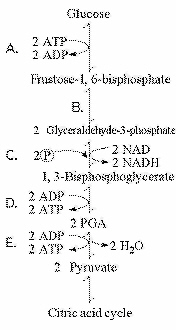
Figure 9.1
|
|
|
36.
|
Which step shows a split of one molecule into two
smaller molecules?
|
|
|
37.
|
In which step is an inorganic phosphate added to
the reactant?
|
|
|
38.
|
In which reaction does an intermediate pathway
become oxidized?
|
|
|
39.
|
Which step involves an endergonic
reaction?
|
|
|
40.
|
Which step consists of a phosphorylation reaction
in which ATP is the phosphate source?
|