Multiple Choice
Identify the
choice that best completes the statement or answers the question.
|
|
|
The following questions refer to Figure 17.2, a
table of codons.
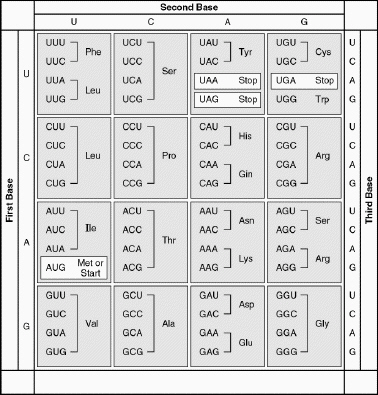
Figure
17.2
|
|
|
1.
|
A possible sequence of nucleotides in the template
strand of DNA that would code for the polypeptide sequence phe-leu-ile-val would be
a. | 5' TTG-CTA-CAG-TAG
3'. | b. | 3' AAC-GAC-GUC-AUA
5'. | c. | 5' AUG-CTG-CAG-TAT
3'. | d. | 3' AAA-AAT-ATA-ACA
5'. | e. | 3' AAA-GAA-TAA-CAA
5'. |
|
|
|
2.
|
What amino acid sequence will be generated, based
on the following mRNA codon sequence?
5' AUG-UCU-UCG-UUA-UCC-UUG 3'
a. | met-arg-glu-arg-glu-arg | b. | met-glu-arg-arg-gln-leu | c. | met-ser-leu-ser-leu-ser | d. | met-ser-ser-leu-ser-leu | e. | met-leu-phe-arg-glu-glu |
|
|
|
3.
|
A peptide has the sequence
NH2-phe-pro-lys-gly-phe-pro-COOH. Which of the following sequences in the coding strand of the DNA
could code for this peptide?
a. | 3'
UUU-CCC-AAA-GGG-UUU-CCC | b. | 3'
AUG-AAA-GGG-TTT-CCC-AAA-GGG | c. | 5'
TTT-CCC-AAA-GGG-TTT-CCC | d. | 5'
GGG-AAA-TTT-AAA-CCC-ACT-GGG | e. | 5'
ACT-TAC-CAT-AAA-CAT-TAC-UGA |
|
|
|
4.
|
What is the sequence of a peptide based on the
following mRNA sequence?
5' . . . UUUUCUUAUUGUCUU 3'
a. | leu-cys-tyr-ser-phe | b. | cyc-phe-tyr-cys-leu | c. | phe-leu-ile-met-val | d. | leu-pro-asp-lys-gly | e. | phe-ser-tyr-cys-leu |
|
|
|
5.
|
The genetic code is essentially the same for all
organisms. From this, one can logically assume all of the following except
a. | a gene from an organism could theoretically be expressed
by any other organism. | b. | all organisms have
a common ancestor. | c. | DNA was the first
genetic material. | d. | the same codons in
different organisms usually translate into the same amino acids. | e. | different organisms have the same number of different types of amino
acids. |
|
|
|
6.
|
Which of the following is true for both
prokaryotic and eukaryotic gene expression?
a. | After transcription, a 3' poly-A tail and a 5'
cap are added to mRNA. | b. | Translation of
mRNA can begin before transcription is complete. | c. | RNA polymerase binds to the promoter region to begin
transcription. | d. | mRNA is
synthesized in the 3' ® 5'
direction. | e. | The mRNA
transcript is the exact complement of the gene from which it was
copied. |
|
|
|
7.
|
RNA polymerase moves in which direction along the
DNA?
a. | 3' ® 5' along
the template strand | b. | 3' ® 5' along the coding (sense) strand | c. | 5' ® 3' along the template
strand | d. | 3' ® 5' along
the coding strand | e. | 5' ® 3' along the double-stranded
DNA |
|
|
|
8.
|
What are the coding segments of a stretch of
eukaryotic DNA called?
a. | introns | b. | exons | c. | codons | d. | replicons | e. | transposons |
|
|
|
9.
|
Once transcribed, eukaryotic mRNA typically
undergoes substantial alteration that includes
a. | union with ribosomes. | b. | fusion into circular forms known as plasmids. | c. | linkage to histone molecules. | d. | excision of introns. | e. | fusion with other
newly transcribed mRNA. |
|
|
|
10.
|
Introns are significant to biological evolution
because
a. | their presence allows exons to be
shuffled. | b. | they protect the mRNA from
degeneration. | c. | they are
translated into essential amino acids. | d. | they maintain the
genetic code by preventing incorrect DNA base pairings. | e. | they correct enzymatic alterations of DNA
bases. |
|
|
|
11.
|
A mutation in which of the following parts of a
gene is likely to be most damaging to a cell?
a. | intron | b. | exon | c. | 5'
UTR | d. | 3' UTR | e. | All would be equally damaging. |
|
|
|
12.
|
A particular triplet of bases in the coding
sequence of DNA is AAA. The anticodon on the tRNA that binds the mRNA codon is
a. | TTT. | b. | UUA. | c. | UUU. | d. | AAA. | e. | either UAA or TAA,
depending on first base wobble. |
|
|
|
13.
|
What type of bonding is responsible for maintaining
the shape of the tRNA molecule?
a. | covalent bonding between sulfur
atoms | b. | ionic bonding between
phosphates | c. | hydrogen bonding
between base pairs | d. | van der Waals
interactions between hydrogen atoms | e. | peptide bonding
between amino acids |
|
|
|
14.
|
What is the most abundant type of
RNA?
a. | mRNA | b. | tRNA | c. | rRNA | d. | pre-mRNA | e. | hnRNA |
|
|
|
15.
|
When does translation begin in prokaryotic
cells?
a. | after a transcription initiation complex has been
formed | b. | as soon as transcription has
begun | c. | after the 5' caps are converted to
mRNA | d. | once the pre-mRNA has been converted to
mRNA | e. | as soon as the DNA introns are removed from the
template |
|
|
|
16.
|
When a tRNA molecule is shown twisted into an L
shape, the form represented is
a. | its linear sequence. | b. | its 2-dimensional shape. | c. | its 3-dimensional
shape. | d. | its microscopic
image. |
|
|
|
17.
|
Why might a point mutation in DNA make a difference
in the level of protein's activity?
a. | It might result in a chromosomal
translocation. | b. | It might exchange
one stop codon for another stop codon. | c. | It might exchange
one serine codon for a different serine codon. | d. | It might
substitute an amino acid in the active site. | e. | It might
substitute the N terminus of the polypeptide for the C
terminus. |
|
|
|
18.
|
In the 1920s Muller discovered that X-rays caused
mutation in Drosophila. In a related series of experiments, in the 1940s, Charlotte Auerbach
discovered that chemicals—she used nitrogen mustards—have a similar effect. A new
chemical food additive is developed by a cereal manufacturer. Why do we test for its ability to
induce mutation?
a. | We worry that it might cause mutation in cereal grain
plants. | b. | We want to make sure that it does not emit
radiation. | c. | We want to be sure
that it increases the rate of mutation sufficiently. | d. | We want to prevent any increase in mutation
frequency. | e. | We worry about its
ability to cause infection. |
|
|
|
19.
|
Which of the following types of mutation, resulting
in an error in the mRNA just after the AUG start of translation, is likely to have the most serious
effect on the polypeptide product?
a. | a deletion of a codon | b. | a deletion of 2 nucleotides | c. | a substitution of the third nucleotide in an ACC
codon | d. | a substitution of the first nucleotide of a GGG
codon | e. | an insertion of a
codon |
|
|
|
20.
|
Each of the following options is a modification of
the sentence THECATATETHERAT. Which of the following is analogous to a frameshift
mutation?
a. | THERATATETHECAT | b. | THETACATETHERAT | c. | THECATARETHERAT | d. | THECATATTHERAT | e. | CATATETHERAT |
|
|
|
21.
|
Each of the following options is a modification of
the sentence THECATATETHERAT. Which of the following is analogous to a single substitution
mutation?
a. | THERATATETHECAT | b. | THETACATETHERAT | c. | THECATARETHERAT | d. | THECATATTHERAT | e. | CATATETHERAT |
|
|
|
22.
|
Sickle-cell disease is probably the result of which
kind of mutation?
a. | point | b. | frameshift | c. | nonsense | d. | nondisjunction | e. | both B and
D |
|
|
|
23.
|
A frameshift mutation could result
from
a. | a base insertion only. | b. | a base deletion only. | c. | a base
substitution only. | d. | deletion of three
consecutive bases. | e. | either an
insertion or a deletion of a base. |
|
|
|
24.
|
Which of the following DNA mutations is the most
likely to be damaging to the protein it specifies?
a. | a base-pair deletion | b. | a codon substitution | c. | a substitution in
the last base of a codon | d. | a codon
deletion | e. | a point mutation |
|
|
|
25.
|
Which point mutation would be most likely to have a
catastrophic effect on the functioning of a protein?
a. | a base substitution | b. | a base deletion near the start of a gene | c. | a base deletion near the end of the coding sequence, but not in the terminator
codon | d. | deletion of three bases near the start of the coding
sequence, but not in the initiator codon | e. | a base insertion
near the end of the coding sequence, but not in the terminator
codon |
|
|
|
26.
|
Of the following, which is the most current
description of a gene?
a. | a unit of heredity that causes formation of a phenotypic
characteristic | b. | a DNA subunit that
codes for a single complete protein | c. | a DNA sequence
that is expressed to form a functional product: either RNA or polypeptide | d. | a DNA—RNA sequence combination that results in an enzymatic
product | e. | a discrete unit of hereditary information that consists
of a sequence of amino acids |
|
|
|
27.
|
The anticodon of a particular tRNA molecule
is
a. | complementary to the corresponding mRNA
codon. | b. | complementary to the corresponding triplet in
rRNA. | c. | the part of tRNA that bonds to a specific amino
acid. | d. | changeable, depending on the amino acid that attaches to
the tRNA. | e. | catalytic, making the tRNA a
ribozyme. |
|