Multiple Choice
Identify the
choice that best completes the statement or answers the question.
|
|
|
1.
|
When Thomas Hunt Morgan crossed his red-eyed  generation flies to each other, the generation flies to each other, the  generation included both
red- and white-eyed flies. Remarkably, all the white-eyed flies were male. What was the explanation
for this result? generation included both
red- and white-eyed flies. Remarkably, all the white-eyed flies were male. What was the explanation
for this result?
a. | The gene involved is on the X
chromosome. | b. | The gene involved
is on the Y chromosome. | c. | The gene involved
is on an autosome. | d. | Other
male-specific factors influence eye color in flies. | e. | Other female-specific factors influence eye color in
flies. |
|
|
|
2.
|
A man with Klinefelter syndrome (47, XXY) is
expected to have any of the following EXCEPT
a. | lower sperm count. | b. | possible breast enlargement. | c. | increased testosterone. | d. | long
limbs. | e. | female body
characteristics. |
|
|
|
3.
|
A woman is found to have 47 chromosomes, including
3 X chromosomes. Which of the following describes her expected phenotype?
a. | Masculine characteristics such as facial
hair | b. | Enlarged genital structures | c. | Excessive emotional instability | d. | Normal female | e. | Sterile
female |
|
|
|
4.
|
Males are more often affected by sex-linked traits
than females because
a. | males are hemizygous for the X
chromosome. | b. | male hormones such
as testosterone often alter the effects of mutations on the X chromosome. | c. | female hormones such as estrogen often compensate for the effects of mutations
on the X. | d. | X chromosomes in males generally have more mutations
than X chromosomes in females. | e. | mutations on the Y
chromosome often worsen the effects of X-linked mutations. |
|
|
|
5.
|
What is the chromosomal system for determining sex
in mammals?
a. | Haploid-diploid | b. | X-0 | c. | X-X | d. | X-Y | e. | Z-W |
|
|
|
6.
|
Red-green color blindness is a sex-linked recessive
trait in humans. Two people with normal color vision have a color-blind son. What are the genotypes
of the parents?
|
|
|
Refer to the following information to answer the
questions below.
A man who is an achondroplastic dwarf with normal vision marries a
color-blind woman of normal height. The man's father was six feet tall, and both the
woman's parents were of average height. Achondroplastic dwarfism is autosomal dominant, and
red-green color blindness is X-linked recessive.
|
|
|
7.
|
How many of their daughters might be expected to be
color-blind dwarfs?
a. | All | b. | None | c. | Half | d. | One out of
four | e. | Three out of four |
|
|
|
8.
|
What proportion of their sons would be color-blind
and of normal height?
a. | All | b. | None | c. | Half | d. | One out of
four | e. | Three out of four |
|
|
|
9.
|
They have a daughter who is a dwarf with normal
color vision. What is the probability that she is heterozygous for both genes?
a. | 0 | b. | 0.25 | c. | 0.50 | d. | 0.75 | e. | 1.00 |
|
|
|
10.
|
A Barr body is normally found in the nucleus of
which kind of human cell?
a. | Unfertilized egg cells only | b. | Sperm cells only | c. | Somatic cells of a
female only | d. | Somatic cells of a
male only | e. | Both male and female somatic
cells |
|
|
|
11.
|
Which of the following statements is
true?
a. | The closer two genes are on a chromosome, the lower the
probability that a crossover will occur between them. | b. | The observed frequency of recombination of two genes that are far apart from
each other has a maximum value of 100%. | c. | All of the traits
that Mendel studied—seed color, pod shape, flower color, and others—are due to genes
linked on the same chromosome. | d. | Linked genes are
found on different chromosomes. | e. | Crossing over
occurs during prophase II of meiosis. |
|
|
|
12.
|
New combinations of linked genes are due to which
of the following?
a. | Nondisjunction | b. | Crossing over | c. | Independent
assortment | d. | Mixing of sperm
and egg | e. | Deletions |
|
|
|
13.
|
What does a frequency of recombination of 50%
indicate?
a. | The two genes are likely to be located on different
chromosomes. | b. | All of the
offspring have combinations of traits that match one of the two parents. | c. | The genes are located on sex chromosomes. | d. | Abnormal meiosis has occurred. | e. | Independent assortment is hindered. |
|
|
|
14.
|
The following is a map of four genes on a
chromosome:
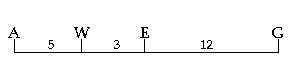
Figure 15.1
Between which
two genes would you expect the highest frequency of recombination?
a. | A and W | b. | W and E | c. | E and
G | d. | A and E | e. | A and G |
|
|
|
15.
|
What is the reason that linked genes are inherited
together?
a. | They are located close together on the same
chromosome. | b. | The number of
genes in a cell is greater than the number of chromosomes. | c. | Chromosomes are unbreakable. | d. | Alleles are paired together during meiosis. | e. | Genes align that way during metaphase I of
meiosis. |
|
|
|
16.
|
What is the mechanism for the production of genetic
recombinants?
a. | X inactivation | b. | Methylation of cytosine | c. | Crossing over and
independent assortment | d. | Nondisjunction | e. | Deletions and
duplications during meiosis |
|
|
|
Refer to Figure 15.2 to answer the following
questions.
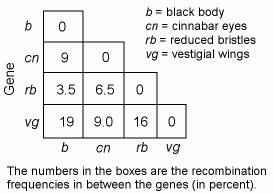
Figure 15.2
|
|
|
17.
|
In a series of mapping experiments, the
recombination frequencies for four different linked genes of Drosophila were determined as
shown in the figure. What is the order of these genes on a chromosome map?
a. | rb-cn-vg-b | b. | vg-b-rb-cn | c. | cn-rb-b-vg | d. | b-rb-cn-vg | e. | vg-cn-b-rb |
|
|
|
18.
|
Which of the following two genes are closest on a
genetic map of Drosophila?
a. | b and vg | b. | vg and cn | c. | rb and
cn | d. | cn and b | e. | b and rb |
|
|
|
D, F, and J are three genes in Drosophila. The
recombination frequencies for two of the three genes are shown in Figure 15.3.
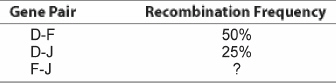
Figure 15.3
|
|
|
19.
|
Genes D and F could be
a. | located on different
chromosomes. | b. | located very near
to each other on the same chromosome. | c. | located far from
each other on the same chromosome. | d. | Both A and
B | e. | Both A and C |
|
|
|
20.
|
The frequency of crossing over between any two
linked genes will be which of the following?
a. | Higher if they are recessive | b. | Dependent on how many alleles there are | c. | Determined by their relative dominance | d. | The same as if they were not linked | e. | Proportional to the distance between
them |
|
|
|
21.
|
Map units on a linkage map cannot be relied upon to
calculate physical distances on a chromosome for which of the following reasons?
a. | The frequency of crossing over varies along the length
of the chromosome. | b. | The relationship
between recombination frequency and map units is different in every
individual. | c. | Physical distances
between genes change during the course of the cell cycle. | d. | The gene order on the chromosomes is slightly different in every
individual. | e. | Linkage map
distances are identical between males and females. |
|
|
|
22.
|
Which of the following is a map of a chromosome
that includes the positions of genes relative to visible chromosomal features, such as stained
bands?
a. | Linkage map | b. | Physical map | c. | Recombination
map | d. | Cytogenetic map | e. | Banded map |
|
|
|
23.
|
If a human interphase nucleus contains three Barr
bodies, it can be assumed that the person
a. | has hemophilia. | b. | is a male. | c. | has four X
chromosomes. | d. | has Turner
syndrome. | e. | has Down
syndrome. |
|
|
|
24.
|
A cell that has 2n + 1 chromosomes
is
a. | trisomic. | b. | monosomic. | c. | euploid. | d. | polyploid. | e. | triploid. |
|
|
|
25.
|
Women with Turner syndrome have a genotype
characterized as which of the following?
a. | aabb | b. | Mental retardation and short arms | c. | A karyotype of 45, X | d. | A karyotype of 47,
XXX | e. | A deletion of the Y
chromosome |
|
|
|
26.
|
The frequency of Down syndrome in the human
population is most closely correlated with which of the following?
a. | Frequency of new meiosis | b. | Average of the ages of mother and father | c. | Age of the mother | d. | Age of the
father | e. | Exposure of pregnant women to environmental
pollutants |
|
|
|
27.
|
What is the source of the extra chromosome 21 in an
individual with Down syndrome?
a. | Nondisjunction in the mother
only | b. | Nondisjunction in the father
only | c. | Duplication of the chromosome | d. | Nondisjunction or translocation in either parent | e. | It is impossible to detect with current
technology |
|
|
|
28.
|
A couple has a child with Down syndrome when the
mother is 39 years old at the time of delivery. Which is the most probable cause?
a. | The woman inherited this tendency from her
parents. | b. | One member of the couple carried a
translocation. | c. | One member of the
couple underwent nondisjunction in somatic cell production. | d. | One member of the couple underwent nondisjunction in gamete
production. |
|
|
|
29.
|
In order for chromosomes to undergo inversion or
translocation, which of the following is required?
a. | Point mutation | b. | Immunological insufficiency | c. | Advanced maternal age | d. | Chromosome
breakage and rejoining | e. | Meiosis |
|
|
|
30.
|
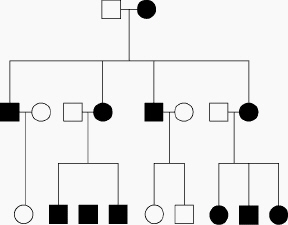
Figure
15.4
The pedigree in Figure 15.4 shows the transmission of a trait in a particular family.
Based on this pattern of transmission, the trait is most likelya. | mitochondrial. | b. | autosomal recessive. | c. | sex-linked
dominant. | d. | sex-linked recessive. | e. | autosomal dominant. |
|