Multiple Choice
Identify the
choice that best completes the statement or answers the question.
|
|
|
1.
|
Catastrophism, meaning the regular occurrence of
geological or meteorological disturbances (catastrophes), was Cuvier's attempt to explain the
existence of
a. | evolution. | b. | the fossil record. | c. | uniformitarianism. | d. | the origin of new
species. | e. | natural
selection. |
|
|
|
2.
|
What was the prevailing notion prior to the time of
Lyell and Darwin?
a. | Earth is a few thousand years old, and populations are
unchanging. | b. | Earth is a few
thousand years old, and populations gradually change. | c. | Earth is millions of years old, and populations rapidly
change. | d. | Earth is millions of years old, and populations are
unchanging. | e. | Earth is millions
of years old, and populations gradually change. |
|
|
|
3.
|
During a study session about evolution, one of your
fellow students remarks, "The giraffe stretched its neck while reaching for higher leaves; its
offspring inherited longer necks as a result." Which statement is most likely to be helpful in
correcting this student's misconception?
a. | Characteristics acquired during an organism's life
are generally not passed on through genes. | b. | Spontaneous
mutations can result in the appearance of new traits. | c. | Only favorable adaptations have survival value. | d. | Disuse of an organ may lead to its eventual
disappearance. | e. | Overproduction of
offspring leads to a struggle for survival. |
|
|
|
4.
|
In the mid-1900s, the Soviet geneticist Lysenko
believed that his winter wheat plants, exposed to ever-colder temperatures, would eventually give
rise to ever more cold-tolerant winter wheat. Lysenko's attempts in this regard were most in
agreement with the ideas of
a. | Cuvier. | b. | Hutton. | c. | Lamarck. | d. | Darwin. | e. | Plato. |
|
|
|
5.
|
Darwin's mechanism of natural selection
required long time spans in order to modify species. From whom did Darwin get the concept of
Earth's ancient age?
a. | Georges Cuvier | b. | Charles Lyell | c. | Alfred
Wallace | d. | Thomas Malthus | e. | John Henslow |
|
|
|
6.
|
Which of these naturalists synthesized a concept of
natural selection independently of Darwin?
a. | Charles Lyell | b. | Gregor Mendel | c. | Alfred
Wallace | d. | John Henslow | e. | Thomas Malthus |
|
|
|
7.
|
Charles Darwin was the first person to
propose
a. | that evolution occurs. | b. | a mechanism for how evolution occurs. | c. | that the Earth is older than a few thousand years. | d. | a mechanism for evolution that was supported by
evidence. | e. | a way to use artificial selection as a means of
domesticating plants and animals. |
|
|
|
8.
|
It has been observed that organisms on islands are
different from, but closely related to, similar forms found on the nearest continent. This is taken
as evidence that
a. | island forms and mainland forms descended from common
ancestors. | b. | common
environments are inhabited by the same organisms. | c. | the islands were originally part of the continent. | d. | the island forms and mainland forms are converging. | e. | island forms and mainland forms have identical gene
pools. |
|
|
|
9.
|
The theory of evolution is most accurately
described as
a. | an educated guess about how species
originate. | b. | one possible
explanation, among several scientific alternatives, about how species have come into
existence. | c. | an opinion that
some scientists hold about how living things change over time. | d. | an overarching explanation, supported by much evidence, for how populations
change over time. | e. | an idea about how
acquired characteristics are passed on to subsequent
generations. |
|
|
|
10.
|
Which of the following pairs of structures is
least likely to represent homology?
a. | The wings of a bat and the arms of a
human | b. | The hemoglobin of a baboon and that of a
gorilla | c. | The mitochondria of a plant and those of an
animal | d. | The wings of a bird and those of an
insect | e. | The brain of a cat and that of a
dog |
|
|
|
11.
|
Which of these is a statement that Darwin would
have rejected?
a. | Environmental change plays a role in
evolution. | b. | The smallest
entity that can evolve is an individual organism. | c. | Individuals can acquire new characteristics as they respond to new
environments or situations. | d. | Inherited
variation in a population is a necessary precondition for natural selection to
operate. | e. | Natural populations tend to produce more offspring than
the environment can support. |
|
|
|
12.
|
About which of these did Darwin have a poor
understanding?
a. | that individuals in a population exhibit a good deal of
variation | b. | that much of the variation between individuals in a
population is inherited | c. | the factors that
cause individuals in populations to struggle for survival | d. | the sources of genetic variations among individuals | e. | how a beneficial trait becomes more common in a population over the course of
generations |
|
|
|
13.
|
If, on average, 46% of the loci in a species'
gene pool are heterozygous, then the average homozygosity of the species should be
a. | 23% | b. | 46% | c. | 54% | d. | 92% | e. | There is not
enough information to say. |
|
|
|
14.
|
Which of these is the smallest unit upon which
natural selection directly acts?
a. | a species' gene
frequency | b. | a population's gene
frequency | c. | an individual's genome | d. | an individual's genotype | e. | an individual's phenotype |
|
|
|
15.
|
Which of these is the smallest unit that natural
selection can change?
a. | a species' gene
frequency | b. | a population's gene
frequency | c. | an individual's genome | d. | an individual's genotype | e. | an individual's phenotype |
|
|
|
16.
|
Each of the following has a better chance of
influencing gene frequencies in small populations than in large populations, but which one most
consistently requires a small population as a precondition for its occurrence?
a. | Mutation | b. | Non-random mating | c. | Genetic
drift | d. | Natural selection | e. | Gene flow |
|
|
|
17.
|
In modern terminology, diversity is understood to
be a result of genetic variation. Sources of variation for evolution include all of the following
except
a. | mistakes in translation of structural
genes. | b. | mistakes in DNA replication. | c. | translocations and mistakes in meiosis. | d. | recombination at fertilization. | e. | recombination by crossing over in
meiosis. |
|
|
|
18.
|
The DNA polymerases of all cellular organisms have
proofreading capability. This capability tends to reduce the introduction of
a. | extra genes by gene duplication
events. | b. | chromosomal translocation. | c. | genetic variation by mutations. | d. | proofreading capability into
prokaryotes. |
|
|
|
19.
|
Which of these makes determining the evolutionary
relatedness of different species based on the amino acid sequence of homologous proteins generally
less accurate than determinations of relatedness based on the nucleotide sequences of homologous
genes?
a. | Silent mutations | b. | Gene duplications | c. | Translocation
events that change gene sequences | d. | Crossing-over | e. | Independent
assortment |
|
|
|
Use the following information to answer the
questions below.
In a hypothetical population of 1,000 people, tests of blood-type genes
show that 160 have the genotype AA, 480 have the genotype AB, and 360 have the genotype
BB.
|
|
|
20.
|
What is the frequency of the B
allele?
a. | 0.001 | b. | 0.002 | c. | 0.100 | d. | 0.400 | e. | 0.600 |
|
|
|
21.
|
If there are 4,000 children born to this
generation, how many would be expected to have AB blood under the conditions of Hardy-Weinberg
equilibrium?
a. | 100 | b. | 960 | c. | 1,920 | d. | 2,000 | e. | 2,400 |
|
|
|
22.
|
In peas, a gene controls flower color such that
R = purple and r = white. In an isolated pea patch, there are 36 purple-flowering plants
and 64 white-flowering plants. Assuming Hardy-Weinberg equilibrium, what is the value of q for
this population?
a. | 0.36 | b. | 0.60 | c. | 0.64 | d. | 0.75 | e. | 0.80 |
|
|
|
23.
|
Over time, the movement of people on Earth has
steadily increased. This has altered the course of human evolution by increasing
a. | non-random mating. | b. | geographic isolation. | c. | genetic
drift. | d. | mutations. | e. | gene flow. |
|
|
|
The following questions refer to this
information:
Adult male humans generally have deeper voices than do adult female humans,
as the direct result of higher levels of testosterone causing growth of the larynx.
|
|
|
24.
|
If one excludes the involvement of gender in the
situation described in the paragraph above, then the pattern that is apparent in the fossil record is
most similar to one that should be expected from
a. | pansexual selection. | b. | directional selection. | c. | disruptive
selection. | d. | stabilizing
selection. | e. | asexual
selection. |
|
|
|
25.
|
The Darwinian fitness of an individual is measured
most directly by
a. | the number of its offspring that survive to
reproduce. | b. | the number of
"good genes" it possesses. | c. | the number of
mates it attracts. | d. | its physical
strength. | e. | how long it
lives. |
|
|
|
In a very large population, a quantitative trait
has the following distribution pattern:
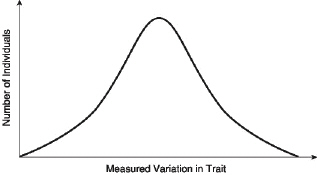
Figure 23.1
|
|
|
26.
|
What is true of the trait whose frequency
distribution in a large population appears above? It has probably undergone
a. | directional selection. | b. | stabilizing selection. | c. | disruptive
selection. | d. | sexual
selection. | e. | random
selection. |
|
|
|
27.
|
If the curve shifts to the left or to the right,
there is no gene flow, and the population size consequently increases over successive generations,
then which of these is (are) probably occurring?
1. immigration or emigration
2. directional selection
3.
adaptation
4. genetic drift
5. disruptive selection
a. | 1 only | b. | 4 only | c. | 2 and
3 | d. | 4 and 5 | e. | 1, 2, and 3 |
|
|
|
28.
|
Which of the following statements about species, as
defined by the biological species concept, is (are) correct?
| I. | Biological species are defined by reproductive
isolation. | | II. | Biological species are the model used for grouping extinct forms of
life. | | III. | The
biological species is the largest unit of population in which successful reproduction is
possible. | | |
a. | I only | b. | II only | c. | I and
III | d. | II and III | e. | I, II, and III |
|
|
|
29.
|
There is still some controversy among biologists
about whether Neanderthals should be placed within the same species as modern humans, or into a
separate species of their own. Most DNA sequence data analyzed so far indicate that there was
probably little or no gene flow between Neanderthals and Homo sapiens. Which species concept
is most applicable in this example?
a. | phylogenetic | b. | ecological | c. | morphological | d. | biological |
|
|
|
30.
|
What was the species concept most used by
Linnaeus?
a. | biological | b. | morphological | c. | ecological | d. | phylogenetic |
|
|
|
31.
|
You are confronted with a box of preserved
grasshoppers of various species that are new to science and have not been described. Your assignment
is to separate them into species. There is no accompanying information as to where or when they were
collected. Which species concept will you have to use?
a. | biological | b. | phylogenetic | c. | ecological | d. | morphological |
|
|
|
The questions below are based on the following
description.
Several closely related frog species of the genus Rana are found in
the forests of the southeastern United States. The species boundaries are maintained by reproductive
barriers. In each case, match the various descriptions of frogs below with the appropriate
reproductive barrier listed.
|
|
|
32.
|
Males of one species sing only when its predators
are absent; males of another species sing only when its predators are present.
a. | behavioral | b. | gametic | c. | habitat | d. | temporal | e. | mechanical |
|
|
|
33.
|
One species lives only in tree holes; another
species lives only in streams.
a. | behavioral | b. | gametic | c. | habitat | d. | temporal | e. | mechanical |
|
|
|
34.
|
Females of one species choose mates based on song
quality; females of another species choose mates on the basis of size.
a. | behavioral | b. | gametic | c. | habitat | d. | temporal | e. | mechanical |
|
|
|
35.
|
One species mates at the season when daylight is
increasing from 13 hours to 13 hours, 15 minutes; another species mates at the season when daylight
is increasing from 14 hours to 14 hours, 15 minutes.
a. | behavioral | b. | gametic | c. | habitat | d. | temporal | e. | mechanical |
|
|
|
36.
|
Males of one species are too small to perform
amplexus (an action that stimulates ovulation) with females of all other species.
a. | behavioral | b. | gametic | c. | habitat | d. | temporal | e. | mechanical |
|
|
|
37.
|
A hybrid zone is properly defined as
a. | an area where two closely related species' ranges
overlap. | b. | an area where mating occurs between members of two
closely related species, producing viable offspring. | c. | a zone that features a gradual change in species composition where two
neighboring ecosystems border each other. | d. | a zone that
includes the intermediate portion of a cline. | e. | an area where
members of two closely related species intermingle, but experience no gene
flow. |
|
|
|
38.
|
In the narrow hybrid zone that separates the toad
species Bombina bombina and Bombina variegata, what is true of those alleles that are
unique to the parental species?
a. | Such alleles should be
absent. | b. | Their allele frequency should be nearly the same as the
allele frequencies in toad populations distant from the hybrid zone. | c. | The alleles' heterozygosity should be higher among the hybrid toads
there. | d. | Their allele frequency on one edge of the hybrid zone
should roughly equal their frequency on the opposite edge of the hybrid
zone. |
|
|
|
The following questions refer to the description
below.
On the volcanic, equatorial West African island of Sao Tomé, two species of
fruit fly exist. Drosophila yakuba inhabits the island's lowlands, and is also found on
the African mainland, located about 200 miles away. At higher elevations, and found only on Sao
Tomé, is found the very closely related Drosophila santomea. The two species can
hybridize, though male hybrids are sterile. A hybrid zone exists at middle elevations, though hybrids
there are greatly outnumbered by D. santomea. Studies of the two species' nuclear genomes
reveal that D. yakuba on the island is more closely related to mainland D. yakuba than
to D. santomea (2n=4 in both species). Sao Tomé rose from the Atlantic Ocean about 14
million years ago.
|
|
|
39.
|
Which of these reduces gene flow between the gene
pools of the two species on Sao Tomé, despite the existence of hybrids?
a. | hybrid breakdown | b. | hybrid inviability | c. | hybrid
sterility | d. | temporal isolation | e. | a geographic barrier |
|
|
|
40.
|
The observation that island D. yakuba are
more closely related to mainland D. yakuba than island D. yakuba are to D.
santomea is best explained by proposing that D. santomea
a. | descended from a now-extinct, non-African fruit
fly. | b. | arose de novo; that is, had no
ancestors. | c. | descended from a
single colony of D. yakuba, which had been introduced from elsewhere, with no subsequent
colonization events. | d. | descended from an
original colony of D. yakuba, of which there are no surviving members. The current island
D. yakuba represent a second colonization event from
elsewhere. |
|
|
|
41.
|
If a speciation event occurred on Sao Tomé,
producing D. santomea from a parent colony of D. yakuba, then which terms
apply?
| I. | macroevolution | | II. | allopatric speciation | | III. | sympatric speciation | | |
a. | I only | b. | II only | c. | I &
II | d. | I & III |
|
|
|
42.
|
Using only the information provided in the
paragraph, which of these is the best initial hypothesis for how D. santomea descended from
D. yakuba?
a. | geographic isolation | b. | autopolyploidy | c. | habitat
differentiation | d. | sexual
selection | e. | allopolyploidy |
|
|
|
43.
|
Which of these evolutionary trees represents the
situation described in the paragraph above (NOTE: yakuba (I) represents the island
population, and yakuba (M) represents the mainland population)?
|
|
|
44.
|
If the low number of hybrid flies in the hybrid
zone, relative to the number of D. santomea flies there, is due to the fact that hybrids are
poorly adapted to conditions in the hybrid zone, and if fewer hybrid flies are produced with the
passage of time, this is most likely to lead to
a. | fusion. | b. | reinforcement. | c. | stability. | d. | further speciation
events. |
|
|
|
45.
|
Which gas was least abundant in Earth's
early atmosphere, prior to 2 billion years ago?
|
|
|
46.
|
In their laboratory simulations of the early Earth,
Miller and Urey observed the abiotic synthesis of
a. | amino acids. | b. | complex organic polymers. | c. | DNA. | d. | liposomes. | e. | genetic
systems. |
|
|
|
47.
|
The first genes on Earth were
probably
a. | DNA produced by reverse transcriptase from abiotically
produced RNA. | b. | DNA molecules
whose information was transcribed to RNA and later translated in
polypeptides. | c. | auto-catalytic RNA
molecules. | d. | RNA produced by
autocatalytic, proteinaceous enzymes. | e. | oligopeptides
located within protobionts. |
|
|
|
48.
|
RNA molecules can both carry genetic information
and be catalytic. This supports the proposal that
a. | RNA was the first hereditary
information. | b. | protobionts had an
RNA membrane. | c. | RNA could make
energy. | d. | free nucleotides would not have been necessary
ingredients in the synthesis of new RNA molecules. | e. | RNA is a polymer of amino acids. |
|
|
|
49.
|
Approximately how far back in time does the fossil
record extend?
a. | 6,000 years | b. | 3,500,000 years | c. | 6,000,000
years | d. | 3,500,000,000 years | e. | 5,000,000,000,000 years |
|
|
|
The following questions are based on the
observation that several dozen different proteins comprise the prokaryotic flagellum and its
attachment to the prokaryotic cell, producing a highly complex structure.
|
|
|
50.
|
It has been found that certain proteins of the
complex motor that drives bacterial flagella are modified versions of proteins that had previously
belonged to plasma membrane pumps. This is evidence in support of the claim that
a. | some structures are so complex that natural selection
cannot, and will not, explain their origins. | b. | the power of
natural selection allows it to act in an almost predictive fashion, producing organs that will be
needed in future environments. | c. | the motors of
bacterial flagella were originally synthesized abiotically. | d. | natural selection can produce new structures by cobbling together parts of
other structures. | e. | bacteria that
possess flagella must have lost the ability to pump certain chemicals across their plasma
membranes. |
|
|
|
51.
|
An explanation for the evolution of insect wings
suggests that wings began as lateral extensions of the body that were used as heat dissipaters for
thermoregulation. When they had become sufficiently large, these extensions became useful for gliding
through the air, and selection later refined them as flight-producing wings. If this hypothesis is
correct, insect wings could best be described as
a. | adaptations. | b. | mutations. | c. | exaptations. | d. | isolating
mechanisms. | e. | examples of
natural selection's predictive ability. |
|
|
|
52.
|
If one organ is an exaptation of another organ,
then what must be true of these two organs?
a. | They are both vestigial
organs. | b. | They are homologous organs. | c. | They are undergoing convergent evolution. | d. | They are found together in the same hybrid species. | e. | They have the same function. |
|
|
|
53.
|
The oxygen revolution changed Earth's
environment dramatically. Which of the following adaptations took advantage of the presence of free
oxygen in the oceans and atmosphere?
a. | the evolution of cellular respiration, which used oxygen
to help harvest energy from organic molecules | b. | the persistence of
some animal groups in anaerobic habitats | c. | the evolution of
photosynthetic pigments that protected early algae from the corrosive effects of
oxygen | d. | the evolution of chloroplasts after early protists
incorporated photosynthetic cyanobacteria | e. | the evolution of
multicellular eukaryotic colonies from communities of
prokaryotes |
|
|
|
54.
|
The legless condition that is observed in several
groups of extant reptiles is the result of
a. | their common ancestor having been
legless. | b. | a shared adaptation to an arboreal (living in trees)
lifestyle. | c. | several instances
of the legless condition arising independently of each other. | d. | individual lizards adapting to a fossorial (living in burrows) lifestyle
during their lifetimes. |
|
|
|
55.
|
The scientific discipline concerned with
naming organisms is called
a. | taxonomy. | b. | cladistics. | c. | binomial
nomenclature. | d. | systematics. | e. | phylocode |
|
|
|
56.
|
Which of these illustrates the correct
representation of the binomial scientific name for the African lion?
a. | Panthera leo | b. | panthera leo | c. | Panthera
leo | d. | Panthera
Leo | e. | Panthera
leo |
|
|
|
57.
|
The correct sequence, from the most to the least
comprehensive, of the taxonomic levels listed here is
a. | family, phylum, class, kingdom, order, species, and
genus. | b. | kingdom, phylum, class, order, family, genus, and
species. | c. | kingdom, phylum, order, class, family, genus, and
species. | d. | phylum, kingdom, order, class, species, family, and
genus. | e. | phylum, family, class, order, kingdom, genus, and
species. |
|
|
|
58.
|
Phylogenetic hypotheses (such as those represented
by phylogenetic trees) are strongest when
a. | they are based on amino acid sequences from homologous
proteins, as long as the genes that code for such proteins contain no
introns. | b. | each clade is defined by a single derived
character. | c. | they are supported
by more than one kind of evidence, such as when fossil evidence corroborates molecular
evidence. | d. | they are accepted by the foremost authorities in the
field, especially if they have won Nobel Prizes. | e. | they are based on a single DNA sequence that seems to be a shared derived
sequence. |
|
|
|
59.
|
Morphologically, Species A is very similar to four
other species, B—E. Yet the nucleotide sequence deep within an intron in a gene shared by all
five of these eukaryotic species is quite different in Species A compared to that of the other four
species when one studies the nucleotides present at each position.
Figure 26.4
If the sequence of Species A differs from that of the other four
species due to simple misalignment, then what should the computer software find when it compares the
sequence of Species A to those of the other four species?
a. | The nucleotide at position 1 should be different in
Species A, but the same in species B—E. | b. | The nucleotide
sequence of Species A should have long sequences that are nearly identical to those of the other
species, but offset in terms of position number. | c. | The sequences of species B—E, though different from that of Species A,
should be identical to each other, without exception. | d. | If the software compares, not nucleotide sequence, but rather the amino acid
sequence of the actual protein product, then the amino acid sequences of species B-E should be
similar to each other, but very different from that of Species A. | e. | Computer software is useless in determining sequences of introns; it can only
be used with exons. |
|
|
|
The following questions refer to the table below,
which compares the % sequence homology of four different parts (2 introns and 2 exons) of a gene that
is found in five different eukaryotic species. Each part is numbered to indicate its distance from
the promoter (e.g., Intron I is that closest to the promoter). The data reported for Species A were
obtained by comparing DNA from one member of species A to another member of Species A.
% Sequence Homology
| Species | Intron I | Exon I | Intron VI | Exon V | | A | 100%
| 100% | 100% | 100% | | B | 98%
| 99% | 82% | 96% | | C | 98%
| 99% | 89% | 96% | | D | 99%
| 99% | 92% | 97% | | E | 98%
| 99% | 80% | 94% | | | | | |
|
|
|
60.
|
Based on the tabular data, and assuming that time
advances vertically, which cladogram (a type of phylogenetic tree) is the most likely depiction of
the evolutionary relationships among these five species?
|
|
|
61.
|
Based on this tree, which of the following
statements is not correct?
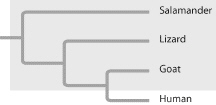
a. | The lineage leading to salamanders was the first to
diverge from the other lineages. | b. | Salamanders are a
sister group to the group containing lizards, goats, and humans. | c. | Salamanders are as closely related to goats as they are to
humans. | d. | Lizards are more closely related to salamanders than
lizards are to humans. | e. | The group
highlighted by shading is paraphyletic. |
|
|
|
62.
|
To apply parsimony to constructing a phylogenetic
tree,
a. | choose the tree that assumes all evolutionary changes
are equally probable. | b. | choose the tree in
which the branch points are based on as many shared derived characters as
possible. | c. | base phylogenetic trees only on the fossil record, as
this provides the simplest explanation for evolution. | d. | choose the tree that represents the fewest evolutionary changes, either in DNA
sequences or morphology. | e. | choose the tree
with the fewest branch points. |
|