Multiple Choice
Identify the
choice that best completes the statement or answers the question.
|
|
|
1.
|
Why did the improvement of microscopy techniques in
the late 1800s set the stage for the emergence of modern genetics?
a. | It revealed new and unanticipated features of
Mendel's pea plant varieties. | b. | It allowed the
study of meiosis and mitosis, revealing parallels between behaviors of genes and
chromosomes. | c. | It allowed
scientists to see the DNA present within chromosomes. | d. | It led to the discovery of mitochondria. | e. | It showed genes functioning to direct the formation of
enzymes. |
|
|
|
2.
|
When Thomas Hunt Morgan crossed his red-eyed  generation flies to each other, the generation flies to each other, the  generation included both
red- and white-eyed flies. Remarkably, all the white-eyed flies were male. What was the explanation
for this result? generation included both
red- and white-eyed flies. Remarkably, all the white-eyed flies were male. What was the explanation
for this result?
a. | The gene involved is on the X
chromosome. | b. | The gene involved
is on the Y chromosome. | c. | The gene involved
is on an autosome. | d. | Other
male-specific factors influence eye color in flies. | e. | Other female-specific factors influence eye color in
flies. |
|
|
|
3.
|
Morgan and his colleagues worked out a set of
symbols to represent fly genotypes. Which of the following are representative?
a. | AaBb ´
AaBb | b. | 46, XY or 46,
XX | c. | vg+vgse+se ´
vgvgsese | d. | +2 ´
+3 |
|
|
|
4.
|
Sturtevant provided genetic evidence for the
existence of four pairs of chromosomes in Drosophila in which of these ways?
a. | There are four major functional classes of genes in
Drosophila. | b. | Drosophila
genes cluster into four distinct groups of linked genes. | c. | The overall number of genes in Drosophila is a multiple of
four. | d. | The entire Drosophila genome has approximately
400 map units. | e. | Drosophila
genes have, on average, four different alleles. |
|
|
|
5.
|
A man with Klinefelter syndrome (47, XXY) is
expected to have any of the following EXCEPT
a. | lower sperm count. | b. | possible breast enlargement. | c. | increased testosterone. | d. | long
limbs. | e. | female body
characteristics. |
|
|
|
6.
|
A woman is found to have 47 chromosomes, including
3 X chromosomes. Which of the following describes her expected phenotype?
a. | Masculine characteristics such as facial
hair | b. | Enlarged genital structures | c. | Excessive emotional instability | d. | Normal female | e. | Sterile
female |
|
|
|
7.
|
Males are more often affected by sex-linked traits
than females because
a. | males are hemizygous for the X
chromosome. | b. | male hormones such
as testosterone often alter the effects of mutations on the X chromosome. | c. | female hormones such as estrogen often compensate for the effects of mutations
on the X. | d. | X chromosomes in males generally have more mutations
than X chromosomes in females. | e. | mutations on the Y
chromosome often worsen the effects of X-linked mutations. |
|
|
|
8.
|
What is the chromosomal system for determining sex
in mammals?
a. | Haploid-diploid | b. | X-0 | c. | X-X | d. | X-Y | e. | Z-W |
|
|
|
9.
|
What is the chromosomal system for sex
determination in birds?
a. | Haploid-diploid | b. | X-0 | c. | X-X | d. | X-Y | e. | Z-W |
|
|
|
10.
|
What is the chromosomal system of sex determination
in most species of ants and bees?
a. | Haploid-diploid | b. | X-0 | c. | X-X | d. | X-Y | e. | Z-W |
|
|
|
11.
|
SRY is best described in which of the following
ways?
a. | A gene region present on the Y chromosome that triggers
male development | b. | A gene present on
the X chromosome that triggers female development | c. | An autosomal gene that is required for the expression of genes on the Y
chromosome | d. | An autosomal gene
that is required for the expression of genes on the X chromosome | e. | Required for development, and males or females lacking the gene do not survive
past early childhood |
|
|
|
12.
|
In cats, black fur color is caused by an
X-linked allele; the other allele at this locus causes orange color. The heterozygote is
tortoiseshell. What kinds of offspring would you expect from the cross of a black female and an
orange male?
a. | Tortoiseshell females; tortoiseshell
males | b. | Black females; orange males | c. | Orange females; orange males | d. | Tortoiseshell females; black males | e. | Orange females; black males |
|
|
|
13.
|
Red-green color blindness is a sex-linked recessive
trait in humans. Two people with normal color vision have a color-blind son. What are the genotypes
of the parents?
|
|
|
14.
|
Cinnabar eyes is a sex-linked recessive
characteristic in fruit flies. If a female having cinnabar eyes is crossed with a wild-type male,
what percentage of the  males will have cinnabar eyes? males will have cinnabar eyes?
a. | 0% | b. | 25% | c. | 50% | d. | 75% | e. | 100% |
|
|
|
15.
|
Calico cats are female because
a. | a male inherits only one of the two X-linked genes
controlling hair color. | b. | the males die
during embryonic development. | c. | the Y chromosome
has a gene blocking orange coloration. | d. | only females can
have Barr bodies. | e. | multiple
crossovers on the Y chromosome prevent orange pigment
production. |
|
|
|
16.
|
In birds, sex is determined by a ZW chromosome
scheme. Males are ZZ and females are ZW. A recessive lethal allele that causes death of the embryo is
sometimes present on the Z chromosome in pigeons. What would be the sex ratio in the offspring of a
cross between a male that is heterozygous for the lethal allele and a normal female?
a. | 2:1 male to female | b. | 1:2 male to female | c. | 1:1 male to
female | d. | 4:3 male to female | e. | 3:1 male to female |
|
|
|
Refer to the following information to answer the
questions below.
A man who is an achondroplastic dwarf with normal vision marries a
color-blind woman of normal height. The man's father was six feet tall, and both the
woman's parents were of average height. Achondroplastic dwarfism is autosomal dominant, and
red-green color blindness is X-linked recessive.
|
|
|
17.
|
How many of their daughters might be expected to be
color-blind dwarfs?
a. | All | b. | None | c. | Half | d. | One out of
four | e. | Three out of four |
|
|
|
18.
|
What proportion of their sons would be color-blind
and of normal height?
a. | All | b. | None | c. | Half | d. | One out of
four | e. | Three out of four |
|
|
|
19.
|
They have a daughter who is a dwarf with normal
color vision. What is the probability that she is heterozygous for both genes?
a. | 0 | b. | 0.25 | c. | 0.50 | d. | 0.75 | e. | 1.00 |
|
|
|
20.
|
A Barr body is normally found in the nucleus of
which kind of human cell?
a. | Unfertilized egg cells only | b. | Sperm cells only | c. | Somatic cells of a
female only | d. | Somatic cells of a
male only | e. | Both male and female somatic
cells |
|
|
|
21.
|
Sex determination in mammals is due to the SRY
region of the Y chromosome. An abnormality could allow which of the following to have a male
phenotype?
a. | Turner syndrome, 45, X | b. | Translocation of SRY to an autosome of a 46, XX
individual | c. | A person with too
many X chromosomes | d. | A person with one
normal and one shortened (deleted) X | e. | Down syndrome, 46,
XX |
|
|
|
22.
|
Which of the following statements is
true?
a. | The closer two genes are on a chromosome, the lower the
probability that a crossover will occur between them. | b. | The observed frequency of recombination of two genes that are far apart from
each other has a maximum value of 100%. | c. | All of the traits
that Mendel studied—seed color, pod shape, flower color, and others—are due to genes
linked on the same chromosome. | d. | Linked genes are
found on different chromosomes. | e. | Crossing over
occurs during prophase II of meiosis. |
|
|
|
23.
|
How would one explain a testcross involving  dihybrid flies in which more parental-type offspring than recombinant-type offspring are
produced? dihybrid flies in which more parental-type offspring than recombinant-type offspring are
produced?
a. | The two genes are linked. | b. | The two genes are linked but on different
chromosomes. | c. | Recombination did
not occur in the cell during meiosis. | d. | The testcross was
improperly performed. | e. | Both of the
characters are controlled by more than one gene. |
|
|
|
24.
|
New combinations of linked genes are due to which
of the following?
a. | Nondisjunction | b. | Crossing over | c. | Independent
assortment | d. | Mixing of sperm
and egg | e. | Deletions |
|
|
|
25.
|
What does a frequency of recombination of 50%
indicate?
a. | The two genes are likely to be located on different
chromosomes. | b. | All of the
offspring have combinations of traits that match one of the two parents. | c. | The genes are located on sex chromosomes. | d. | Abnormal meiosis has occurred. | e. | Independent assortment is hindered. |
|
|
|
26.
|
A 0.1% frequency of recombination is
observed
a. | only in sex chromosomes. | b. | only on genetic maps of viral chromosomes. | c. | on unlinked chromosomes. | d. | in any two genes
on different chromosomes. | e. | in genes located
very close to one another on the same chromosome. |
|
|
|
27.
|
The following is a map of four genes on a
chromosome:
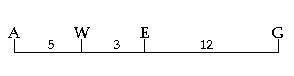
Figure 15.1
Between which
two genes would you expect the highest frequency of recombination?
a. | A and W | b. | W and E | c. | E and
G | d. | A and E | e. | A and G |
|
|
|
28.
|
What is the reason that linked genes are inherited
together?
a. | They are located close together on the same
chromosome. | b. | The number of
genes in a cell is greater than the number of chromosomes. | c. | Chromosomes are unbreakable. | d. | Alleles are paired together during meiosis. | e. | Genes align that way during metaphase I of
meiosis. |
|
|
|
29.
|
What is the mechanism for the production of genetic
recombinants?
a. | X inactivation | b. | Methylation of cytosine | c. | Crossing over and
independent assortment | d. | Nondisjunction | e. | Deletions and
duplications during meiosis |
|
|
|
Refer to Figure 15.2 to answer the following
questions.
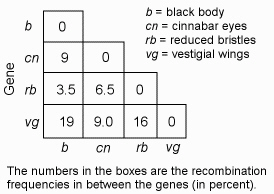
Figure 15.2
|
|
|
30.
|
In a series of mapping experiments, the
recombination frequencies for four different linked genes of Drosophila were determined as
shown in the figure. What is the order of these genes on a chromosome map?
a. | rb-cn-vg-b | b. | vg-b-rb-cn | c. | cn-rb-b-vg | d. | b-rb-cn-vg | e. | vg-cn-b-rb |
|
|
|
31.
|
Which of the following two genes are closest on a
genetic map of Drosophila?
a. | b and vg | b. | vg and cn | c. | rb and
cn | d. | cn and b | e. | b and rb |
|
|
|
D, F, and J are three genes in Drosophila. The
recombination frequencies for two of the three genes are shown in Figure 15.3.
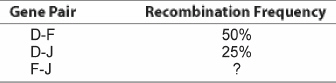
Figure 15.3
|
|
|
32.
|
Genes D and F could be
a. | located on different
chromosomes. | b. | located very near
to each other on the same chromosome. | c. | located far from
each other on the same chromosome. | d. | Both A and
B | e. | Both A and C |
|
|
|
33.
|
The frequency of crossing over between any two
linked genes will be which of the following?
a. | Higher if they are recessive | b. | Dependent on how many alleles there are | c. | Determined by their relative dominance | d. | The same as if they were not linked | e. | Proportional to the distance between
them |
|
|
|
34.
|
Map units on a linkage map cannot be relied upon to
calculate physical distances on a chromosome for which of the following reasons?
a. | The frequency of crossing over varies along the length
of the chromosome. | b. | The relationship
between recombination frequency and map units is different in every
individual. | c. | Physical distances
between genes change during the course of the cell cycle. | d. | The gene order on the chromosomes is slightly different in every
individual. | e. | Linkage map
distances are identical between males and females. |
|
|
|
35.
|
Which of the following is a map of a chromosome
that includes the positions of genes relative to visible chromosomal features, such as stained
bands?
a. | Linkage map | b. | Physical map | c. | Recombination
map | d. | Cytogenetic map | e. | Banded map |
|
|
|
36.
|
If a human interphase nucleus contains three Barr
bodies, it can be assumed that the person
a. | has hemophilia. | b. | is a male. | c. | has four X
chromosomes. | d. | has Turner
syndrome. | e. | has Down
syndrome. |
|
|
|
37.
|
If nondisjunction occurs in meiosis II during
gametogenesis, what will be the result at the completion of meiosis?
a. | All the gametes will be
diploid. | b. | Half of the gametes will be n + 1, and half will
be n - 1. | c. | 1/4 of the gametes
will be n + 1, one will be n - 1, and two will be n. | d. | There will be three extra gametes. | e. | Two of the four gametes will be haploid, and two will be
diploid. |
|
|
|
38.
|
If a pair of homologous chromosomes fails to
separate during anaphase of meiosis I, what will be the chromosome number of the four resulting
gametes with respect to the normal haploid number (n)?
a. | n + 1; n + 1; n - 1; n -
1 | b. | n + 1; n - 1; n;
n | c. | n + 1; n - 1; n - 1; n -
1 | d. | n + 1; n + 1; n;
n | e. | n - 1; n - 1; n;
n |
|
|
|
39.
|
A cell that has 2n + 1 chromosomes
is
a. | trisomic. | b. | monosomic. | c. | euploid. | d. | polyploid. | e. | triploid. |
|
|
|
40.
|
One possible result of chromosomal breakage is for
a fragment to join a nonhomologous chromosome. What is this alteration called?
a. | Deletion | b. | Disjunction | c. | Inversion | d. | Translocation | e. | Duplication |
|
|
|
41.
|
A nonreciprocal crossover causes which of the
following products?
a. | Deletion only | b. | Duplication only | c. | Nondisjunction | d. | Deletion and
duplication | e. | Duplication and
nondisjunction |
|
|
|
42.
|
In humans, male-pattern baldness is controlled by
an autosomal gene that occurs in two allelic forms. Allele Hn determines nonbaldness, and
allele Hb determines pattern baldness. In males, because of the presence of testosterone,
allele Hb is dominant over Hn. If a man and woman both with genotype HnHb have a
son, what is the chance that he will eventually be bald?
|
|
|
43.
|
Of the following human aneuploidies, which is the
one that generally has the most severe impact on the health of the individual?
a. | 47, +21 | b. | 47, XXY | c. | 47,
XXX | d. | 47, XYY | e. | 45, X |
|
|
|
44.
|
A phenotypically normal prospective couple seeks
genetic counseling because the man knows that he has a translocation of a portion of his chromosome 4
that has been exchanged with a portion of his chromosome 12. Although he is normal because his
translocation is balanced, he and his wife want to know the probability that his sperm will be
abnormal. What is your prognosis regarding his sperm?
a. | 1/4 will be normal, 1/4 with the translocation, 1/2 with
duplications and deletions. | b. | All will carry the
same translocation as the father. | c. | None will carry
the translocation since abnormal sperm will die. | d. | His sperm will be sterile and the couple might consider
adoption. | e. | 1/2 will be normal and the rest with the father's
translocation. |
|
|
|
45.
|
Abnormal chromosomes are frequent in malignant
tumors. Errors such as translocations may place a gene in close proximity to different control
regions. Which of the following might then occur to make the cancer worse?
a. | An increase in
non-disjunction | b. | Expression of
inappropriate gene products | c. | A decrease in
mitotic frequency | d. | Death of the
cancer cells in the tumor | e. | Sensitivity of the
immune system |
|
|
|
46.
|
Women with Turner syndrome have a genotype
characterized as which of the following?
a. | aabb | b. | Mental retardation and short arms | c. | A karyotype of 45, X | d. | A karyotype of 47,
XXX | e. | A deletion of the Y
chromosome |
|
|
|
47.
|
The frequency of Down syndrome in the human
population is most closely correlated with which of the following?
a. | Frequency of new meiosis | b. | Average of the ages of mother and father | c. | Age of the mother | d. | Age of the
father | e. | Exposure of pregnant women to environmental
pollutants |
|
|
|
48.
|
An inversion in a human chromosome often results in
no demonstrable phenotypic effect in the individual. What else may occur?
a. | There may be deletions later in
life. | b. | Some abnormal gametes may be
formed. | c. | There is an increased frequency of
mutation. | d. | All inverted chromosomes are
deleted. | e. | The individual is more likely to get
cancer. |
|
|
|
49.
|
What is the source of the extra chromosome 21 in an
individual with Down syndrome?
a. | Nondisjunction in the mother
only | b. | Nondisjunction in the father
only | c. | Duplication of the chromosome | d. | Nondisjunction or translocation in either parent | e. | It is impossible to detect with current
technology |
|
|
|
50.
|
Down syndrome has a frequency in the U.S.
population of ~ 1/700 live births. In which of the following groups would you expect this to be
significantly higher?
a. | People in Latin or South
America | b. | The Inuit and other peoples in very cold
habitats | c. | People living in equatorial areas of the
world | d. | Very small population groups | e. | No groups have such higher frequency |
|
|
|
51.
|
A couple has a child with Down syndrome when the
mother is 39 years old at the time of delivery. Which is the most probable cause?
a. | The woman inherited this tendency from her
parents. | b. | One member of the couple carried a
translocation. | c. | One member of the
couple underwent nondisjunction in somatic cell production. | d. | One member of the couple underwent nondisjunction in gamete
production. |
|
|
|
52.
|
In 1956 Tijo and Levan first successfully counted
human chromosomes. The reason it would have taken so many years to have done so would have included
all but which of the following?
a. | Watson and Crick's structure of DNA was not done
until 1953. | b. | Chromosomes were
piled up on top of one another in the nucleus. | c. | Chromosomes were
not distinguishable during interphase. | d. | A method had not
yet been devised to halt mitosis at metaphase. |
|
|
|
53.
|
At which phase(s) is it preferable to obtain
chromosomes to prepare a karyotype?
a. | Early prophase | b. | Late telophase | c. | Anaphase | d. | Late anaphase or
early telophase | e. | Late prophase or
metaphase |
|
|
|
54.
|
In order for chromosomes to undergo inversion or
translocation, which of the following is required?
a. | Point mutation | b. | Immunological insufficiency | c. | Advanced maternal age | d. | Chromosome
breakage and rejoining | e. | Meiosis |
|
|
|
55.
|
Which of the following statements describes genomic
imprinting?
a. | It explains cases in which the gender of the parent from
whom an allele is inherited affects the expression of that allele. | b. | It is greatest in females because of the larger maternal contribution of
cytoplasm. | c. | It may explain the
transmission of Duchenne muscular dystrophy. | d. | It involves an
irreversible alteration in the DNA sequence of imprinted
genes. |
|
|
|
56.
|
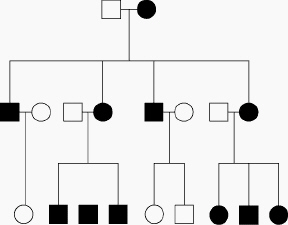
Figure
15.4
The pedigree in Figure 15.4 shows the transmission of a trait in a particular family.
Based on this pattern of transmission, the trait is most likelya. | mitochondrial. | b. | autosomal recessive. | c. | sex-linked
dominant. | d. | sex-linked recessive. | e. | autosomal dominant. |
|
|
|
57.
|
A gene is considered to be non-Mendelian in its
inheritance pattern if it seems to "violate" Mendel's laws. Which of the following
would then NOT be considered non-Mendelian?
a. | A gene whose expression varies depending on the gender
of the transmitting parent | b. | A gene derived
solely from maternal inheritance | c. | A gene transmitted
via the cytoplasm or cytoplasmic structures | d. | A gene transmitted
to males from the maternal line and from fathers to daughters | e. | A gene transmitted by a virus to egg-producing
cells |
|
|
|
58.
|
Genomic imprinting is generally due to the addition
of methyl (-CH3) groups to C nucleotides in order to silence a given gene. If this depends on the sex
of the parent who transmits the gene, which of the following must be true?
a. | Methylation of C is permanent in a
gene. | b. | Genes required for early development stages must not be
imprinted. | c. | Methylation of
this kind must occur more in males than in females. | d. | Methylation must be reversible in ovarian and testicular
cells. | e. | The imprints are transmitted only to gamete-producing
cells. |
|
|
|
59.
|
Correns described that the inheritance of
variegated color on the leaves of certain plants was determined by the maternal parent only. What
phenomenon does this describe?
a. | Mitochondrial inheritance | b. | Chloroplast inheritance | c. | Genomic
imprinting | d. | Infectious
inheritance | e. | Sex-linkage |
|
|
|
60.
|
Mitochondrial DNA is primarily involved in coding
for proteins needed for electron transport. Therefore in which body systems would you expect most
mitochondrial gene mutations to be exhibited?
a. | The immune system and the
blood | b. | Excretory and respiratory
systems | c. | The skin and senses | d. | Nervous and muscular systems | e. | Circulation |
|
|
|
61.
|
A certain kind of snail can have a right-handed
direction of shell coiling (D) or left handed coiling (d). If direction of coiling is
due to a protein deposited by the mother in the egg cytoplasm, then a Dd egg-producing snail
and a dd sperm-producing snail will have offspring of which genotype(s) and
phenotype(s)?
a. | 1/2 Dd : 1/2 dd; all right
coiling | b. | All Dd; all right
coiling | c. | 1/2 Dd : 1/2 dd; half right and half left
coiling | d. | All Dd; all left
coiling | e. | All Dd; half right and half left
coiling |
|
Short Answer
|
|
|
62.
|
A man with hemophilia (a recessive, sex-linked
condition) has a daughter of normal phenotype. She marries a man who is normal for the trait. What is
the probability that a daughter of this mating will be a hemophiliac? That a son will be a
hemophiliac? If the couple has four sons, what is the probability that all four will be born with
hemophilia?
|
|
|
63.
|
Pseudohypertrophic muscular dystrophy is an
inherited disorder that causes gradual deterioration of the muscles. It is seen almost exclusively in
boys born to apparently normal parents and usually results in death in the early teens. Is this
disorder caused by a dominant or a recessive allele? Is its inheritance sex-linked or autosomal? How
do you know? Explain why this disorder is almost never seen in girls.
|
|
|
64.
|
Red-green color blindness is caused by a sex-linked
recessive allele. A color-blind man marries a woman with normal vision whose father was color-blind.
What is the probability that they will have a color-blind daughter? What is the probability that
their first son will be color-blind? (Note the different wording in the two questions.)
|
|
|
65.
|
A wild-type fruit fly (heterozygous for gray body
color and normal wings) is mated with a black fly with vestigial wings. The offspring have the
following phenotypic distribution: wild type, 778; black-vestigial, 785; black-normal, 158;
gray-vestigial, 162. What is the recombination frequency between these genes for body color and wing
size?
|
|
|
66.
|
In another cross, a wild-type fruit fly
(heterozygous for gray body color and red eyes) is mated with a black fruit fly with purple eyes. The
offspring are as follows: wild type, 721; black-purple, 751; gray-purple, 49; black-red, 45. What is
the recombination frequency between these genes for body color and eye color? Using information from
problem 4, what fruit flies (genotypes and phenotypes) would you mate to determine the sequence of
the body-color, wing-size, and eye-color genes on the chromosome?
|
|
|
67.
|
A fruit fly that is true-breeding for gray body,
vestigial wings ( vg vg) is mated with one
that is true-breeding for black body, normal wings (b b vg vg) is mated with one
that is true-breeding for black body, normal wings (b b  ). ).
A)
Draw the chromosomes for each P generation fly, showing the position of each allele.
B) Draw the
chromosomes and label the alleles for an  fly. fly.
C) Suppose an  female is testcrossed. Draw the chromosomes of the resulting offspring in a Punnett square like the
one at the bottom of Fig. 15.10 in your textbook.
female is testcrossed. Draw the chromosomes of the resulting offspring in a Punnett square like the
one at the bottom of Fig. 15.10 in your textbook.
D) Knowing that the distance between these two
genes is 17 map units, predict the phenotypic ratios of these offspring.
|
|
|
68.
|
What pattern of inheritance would lead a geneticist
to suspect that an inherited disorder of cell metabolism is due to a defective mitochondrial
gene?
|
|
|
69.
|
Women born with an extra X chromosome (XXX) are
healthy and phenotypically indistinguishable from normal XX women. What is a likely explanation for
this finding? How could you test this explanation?
|
|
|
70.
|
Determine the sequence of genes along a chromosome
based on the following recombination frequencies: A—B, 8 map units; A—C, 28
map units; A—D, 25 map units; B—C, 20 map units; B—D, 33 map
units.
|
|
|
71.
|
Assume that genes A and B are linked
and are 50 map units apart. An animal heterozygous at both loci is crossed with one that is
homozygous recessive at both loci. What percentage of the offspring will show phenotypes resulting
from crossovers? If you did not know that genes A and B were linked, how would you
interpret the results of this cross?
|
|
|
72.
|
A space probe discovers a planet inhabited by
creatures that reproduce with the same hereditary patterns seen in humans. Three phenotypic
characters are height (T = tall, t = dwarf), head appendages (A = antennae,
a = no antennae), and nose morphology (S = upturned snout, s = downturned
snout). Since the creatures are not “intelligent,” Earth scientists are able to do some
controlled breeding experiments, using various heterozygotes in testcrosses. For tall heterozygotes
with antennae, the offspring are: tall-antennae, 46; dwarf-antennae, 7; dwarf-no antennae, 42;
tall-no antennae, 5. For heterozygotes with antennae and an upturned snout, the offspring are:
antennae-upturned snout, 47; antennae-downturned snout, 2; no antennae-downturned snout, 48; no
antennae-upturned snout, 3. Calculate the recombination frequencies for both
experiments.
|
|
|
73.
|
Two genes of a flower, one controlling blue
(B) versus white (b) petals and the other controlling round (R) versus oval
(r) stamens, are linked and are 10 map units apart. You cross a homozygous blue-oval plant
with a homozygous white-round plant. The resulting F1 progeny are crossed with homozygous white-oval
plants, and 1,000 F2 progeny are obtained. How many F2 plants of each of the four phenotypes do you
expect?
|
|
|
74.
|
You design Drosophila crosses to provide
recombination data for gene a, which is located on the chromosome shown in Figure 15.12 in the
textbook. Gene a has recombination frequencies of 14% with the vestigial-wing locus and 26%
with the brown-eye locus. Where is a located on the chromosome?
|
|
|
75.
|
Bananas plants, which are triploid, are seedless
and therefore sterile. Propose a possible explanation.
|