Multiple Choice
Identify the
choice that best completes the statement or answers the question.
|
|
|
1.
|
Pea plants were particularly well suited for use in
Mendel's breeding experiments for all of the following reasons except that
a. | peas show easily observed variations in a number of
characters, such as pea shape and flower color. | b. | it is possible to
control matings between different pea plants. | c. | it is possible to
obtain large numbers of progeny from any given cross. | d. | peas have an unusually long generation time. | e. | many of the observable characters that vary in pea plants are controlled by
single genes. |
|
|
|
2.
|
What is the difference between a monohybrid cross
and a dihybrid cross?
a. | A monohybrid cross involves a single parent, whereas a
dihybrid cross involves two parents. | b. | A monohybrid cross
produces a single progeny, whereas a dihybrid cross produces two progeny. | c. | A dihybrid cross involves organisms that are heterozygous for two characters
and a monohybrid only one. | d. | A monohybrid cross
is performed for one generation, whereas a dihybrid cross is performed for two
generations. | e. | A monohybrid cross
results in a 9:3:3:1 ratio whereas a dihybrid cross gives a 3:1
ratio. |
|
|
|
3.
|
A cross between homozygous purple-flowered and
homozygous white-flowered pea plants results in offspring with purple flowers. This
demonstrates
a. | the blending model of
genetics. | b. | true-breeding. | c. | dominance. | d. | a dihybrid
cross. | e. | the mistakes made by
Mendel. |
|
|
|
4.
|
The  offspring of Mendel's
classic pea cross always looked like one of the two parental varieties because offspring of Mendel's
classic pea cross always looked like one of the two parental varieties because
a. | one phenotype was completely dominant over
another. | b. | each allele affected phenotypic
expression. | c. | the traits blended
together during fertilization. | d. | no genes
interacted to produce the parental phenotype. | e. | different genes
interacted to produce the parental phenotype. |
|
|
|
5.
|
What was the most significant conclusion that
Gregor Mendel drew from his experiments with pea plants?
a. | There is considerable genetic variation in garden
peas. | b. | Traits are inherited in discrete units, and are not the
results of "blending." | c. | Recessive genes
occur more frequently in the  than do dominant
ones. than do dominant
ones. | d. | Genes are composed of DNA. | e. | An organism that is homozygous for many recessive traits is at a
disadvantage. |
|
|
|
6.
|
How many unique gametes could be produced through
independent assortment by an individual with the genotype AaBbCCDdEE?
|
|
|
7.
|
Two plants are crossed, resulting in offspring with
a 3:1 ratio for a particular trait. This suggests
a. | that the parents were true-breeding for contrasting
traits. | b. | incomplete dominance. | c. | that a blending of traits has occurred. | d. | that the parents were both heterozygous. | e. | that each offspring has the same
alleles. |
|
|
|
8.
|
Two characters that appear in a 9:3:3:1 ratio in
the  generation should have which of the following
properties? generation should have which of the following
properties?
a. | Each of the traits is controlled by single
genes. | b. | The genes controlling the characters obey the law of
independent assortment. | c. | Each of the genes
controlling the characters has two alleles. | d. | Four genes are
involved. | e. | Sixteen different phenotypes are
possible. |
|
|
|
9.
|
A sexually reproducing animal has two unlinked
genes, one for head shape (H) and one for tail length (T). Its genotype is HhTt.
Which of the following genotypes is possible in a gamete from this organism?
|
|
|
10.
|
It was important that Mendel examined not just the
 generation in his breeding experiments, but
the generation in his breeding experiments, but
the  generation as well, because generation as well, because
a. | he obtained very few  progeny,
making statistical analysis difficult. progeny,
making statistical analysis difficult. | b. | parental traits
that were not observed in the  reappeared in the reappeared in the  . . | c. | analysis of the
 progeny would have allowed him to discover
the law of segregation, but not the law of independent assortment. progeny would have allowed him to discover
the law of segregation, but not the law of independent assortment. | d. | the dominant phenotypes were visible in the  generation,
but not in the generation,
but not in the  . . | e. | many of the  progeny
died. progeny
died. |
|
|
|
11.
|
When crossing an organism that is homozygous
recessive for a single trait with a heterozygote, what is the chance of producing an offspring with
the homozygous recessive phenotype?
a. | 0% | b. | 25% | c. | 50% | d. | 75% | e. | 100% |
|
|
|
Use Figure 14.1 and the following description to
answer the questions below.
In a particular plant, leaf color is controlled by gene locus
D. Plants with at least one allele D have dark green leaves, and plants with the
homozygous recessive dd genotype have light green leaves. A true-breeding dark-leaved plant is
crossed with a light-leaved one, and the  offspring is allowed to
self-pollinate. The predicted outcome of the offspring is allowed to
self-pollinate. The predicted outcome of the  is diagrammed in the
Punnett square shown in Figure 14.1, where 1, 2, 3, and 4 represent the genotypes corresponding to
each box within the square. is diagrammed in the
Punnett square shown in Figure 14.1, where 1, 2, 3, and 4 represent the genotypes corresponding to
each box within the square.
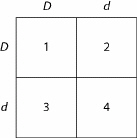
Figure 14.1
|
|
|
12.
|
Which of the boxes marked 1-4 correspond to plants
with dark leaves?
a. | 1 only | b. | 1 and 2 | c. | 2 and
3 | d. | 4 only | e. | 1, 2, and 3 |
|
|
|
13.
|
Which of the boxes correspond to plants with a
heterozygous genotype?
a. | 1 | b. | 1 and
2 | c. | 1, 2, and 3 | d. | 2 and 3 | e. | 2, 3, and
4 |
|
|
|
14.
|
Which of the plants will be
true-breeding?
a. | 1 and 4 | b. | 2 and 3 | c. | 1—4 | d. | 1
only | e. | None |
|
|
|
15.
|
Mendel accounted for the observation that traits
which had disappeared in the  generation reappeared in the generation reappeared in the  generation by proposing that
|
|
|
16.
|
Which of the following about the law of segregation
is false?
a. | It states that each of two alleles for a given trait
segregate into different gametes. | b. | It can be
explained by the segregation of homologous chromosomes during meiosis. | c. | It can account for the 3:1 ratio seen in the  generation
of Mendel's crosses. generation
of Mendel's crosses. | d. | It can be used to
predict the likelihood of transmission of certain genetic diseases within
families. | e. | It is a method that can be used to determine the number
of chromosomes in a plant. |
|
|
|
17.
|
The fact that all seven of the pea plant traits
studied by Mendel obeyed the principle of independent assortment most probably indicates which of the
following?
a. | None of the traits obeyed the law of
segregation. | b. | The diploid number
of chromosomes in the pea plants was 7. | c. | All of the genes
controlling the traits were located on the same chromosome. | d. | All of the genes controlling the traits behaved as if they were on different
chromosomes. | e. | The formation of
gametes in plants occurs by mitosis only. |
|
|
|
18.
|
Mendel was able to draw his ideas of segregation
and independent assortment because of the influence of which of the following?
a. | His reading and discussion of Darwin's Origin of
Species | b. | The understanding
of particulate inheritance he learned from renowned scientists of his time | c. | His discussions of heredity with his colleagues at major
universities | d. | His reading of the
scientific literature current in the field | e. | His experiments
with the breeding of plants such as peas |
|
|
|
19.
|
Mendel's observation of the segregation of
alleles in gamete formation has its basis in which of the following phases of cell
division?
a. | Prophase I of meiosis | b. | Prophase II of meiosis | c. | Metaphase I of
meiosis | d. | Anaphase I of meiosis | e. | Anaphase of mitosis |
|
|
|
20.
|
Mendel's second law of independent assortment
has its basis in which of the following events of meiosis I?
a. | Synapsis of homologous
chromosomes | b. | Crossing
over | c. | Alignment of tetrads at the
equator | d. | Separation of homologs at
anaphase | e. | Separation of cells at
telophase |
|
|
|
21.
|
Black fur in mice (B) is dominant to brown
fur (b). Short tails (T) are dominant to long tails (t). What fraction of the
progeny of the cross BbTt ´ BBtt will have black fur
and long tails?
a. | 1/16 | b. | 3/16 | c. | 3/8 | d. | 1/2 | e. | 9/16 |
|
|
|
22.
|
In certain plants, tall is dominant to short. If a
heterozygous plant is crossed with a homozygous tall plant, what is the probability that the
offspring will be short?
|
|
|
23.
|
Two true-breeding stocks of pea plants are crossed.
One parent has red, axial flowers and the other has white, terminal flowers; all  individuals have red, axial flowers. The genes for flower color and location assort independently. If
1,000
individuals have red, axial flowers. The genes for flower color and location assort independently. If
1,000  offspring resulted from the cross,
approximately how many of them would you expect to have red, terminal flowers? offspring resulted from the cross,
approximately how many of them would you expect to have red, terminal flowers?
|
|
|
24.
|
In a cross AaBbCc ´ AaBbCc, what is the probability of producing the genotype
AABBCC?
a. | 1/4 | b. | 1/8 | c. | 1/16 | d. | 1/32 | e. | 1/64 |
|
|
|
25.
|
Given the parents AABBCc ´ AabbCc, assume simple dominance and independent assortment. What
proportion of the progeny will be expected to phenotypically resemble the first parent?
|
|
|
Use the following information to answer the
questions below.
Labrador retrievers are black, brown, or yellow. In a cross of a black
female with a brown male, results can be either all black puppies, 1/2 black to 1/2 brown puppies, or
3/4 black to 1/4 yellow puppies.
|
|
|
26.
|
These results indicate which of the
following?
a. | Brown is dominant to black. | b. | Black is dominant to brown and to yellow. | c. | Yellow is dominant to black. | d. | There is incomplete dominance. | e. | Epistasis is involved. |
|
|
|
27.
|
How many genes must be responsible for these coat
colors in Labrador retrievers?
|
|
|
28.
|
In one type cross of black ´ black, the results were as follows:
9/16 black
4/16 yellow
3/16
brown
The genotype aabb must result in which of
the following?
a. | Black | b. | Brown | c. | Yellow | d. | A lethal
result |
|
|
|
Use the following information to answer the
questions below.
Radish flowers may be red, purple, or white. A cross between a
red-flowered plant and a white-flowered plant yields all-purple offspring. The part of the radish we
eat may be oval or long, with long being the dominant characteristic.
|
|
|
29.
|
If true-breeding red long radishes are crossed with
true breeding white oval radishes, the  will be expected to be which of the
following? will be expected to be which of the
following?
a. | Red and long | b. | Red and oval | c. | White and
long | d. | Purple and long | e. | Purple and oval |
|
|
|
30.
|
In the  generation of the above
cross, which of the following phenotypic ratios would be expected? generation of the above
cross, which of the following phenotypic ratios would be expected?
a. | 9:3:3:1 | b. | 9:4:3 | c. | 1:1:1:1 | d. | 1:1:1:1:1:1 | e. | 6:3:3:2:1:1 |
|
|
|
31.
|
Drosophila (fruit flies) usually have long
wings (+) but mutations in two different genes can result in bent wings (bt) or vestigial wings (vg).
If a homozygous bent wing fly is mated with a homozygous vestigial wing fly, which of the following
offspring would you expect?
a. | All +bt +vg heterozygotes | b. | 1/2 bent and 1/2 vestigial flies | c. | All homozygous + flies | d. | 3/4 bent to 1/4
vestigial ratio | e. | 1/2 bent and
vestigial to 1/2 normal |
|
|
|
32.
|
The flower color trait in radishes is an example of
which of the following?
a. | A multiple allelic system | b. | Sex linkage | c. | Codominance | d. | Incomplete
dominance | e. | Epistasis |
|
|
|
33.
|
A 1:2:1 phenotypic ratio in the  generation of a monohybrid cross is a sign of
a. | complete dominance. | b. | multiple alleles. | c. | incomplete
dominance. | d. | polygenic
inheritance. | e. | pleiotropy. |
|
|
|
34.
|
In snapdragons, heterozygotes for one of the genes
have pink flowers, whereas homozygotes have red or white flowers. When plants with red flowers are
crossed with plants with white flowers, what proportion of the offspring will have pink
flowers?
a. | 0% | b. | 25% | c. | 50% | d. | 75% | e. | 100% |
|
|
|
35.
|
Tallness (T) in snapdragons is dominant to
dwarfness (t), while red (R) flower color is dominant to white (r). The
heterozygous condition results in pink (Rr) flower color. A dwarf, red snapdragon is crossed
with a plant homozygous for tallness and white flowers. What are the genotype and phenotype of the
 individuals? individuals?
a. | ttRr–dwarf and
pink | b. | ttrr–dwarf and
white | c. | TtRr–tall and
red | d. | TtRr–tall and
pink | e. | TTRR–tall and
red |
|
|
|
36.
|
Skin color in a certain species of fish is
inherited via a single gene with four different alleles. How many different types of gametes would be
possible in this system?
|
|
|
37.
|
In cattle, roan coat color (mixed red and white
hairs) occurs in the heterozygous (Rr) offspring of red (RR) and white
(rr) homozygotes. Which of the following crosses would produce offspring in the
ratio of 1 red : 2 roan : 1 white?
a. | red ´
white | b. | roan ´
roan | c. | white ´
roan | d. | red ´
roan | e. | The answer cannot be determined from the information
provided. |
|
|
|
Refer to the following to answer the questions
below.
Gene S controls the sharpness of spines in a type of cactus. Cactuses with
the dominant allele, S, have sharp spines, whereas homozygous recessive ss cactuses
have dull spines. At the same time, a second gene, N, determines whether cactuses have spines.
Homozygous recessive nn cactuses have no spines at all.
|
|
|
38.
|
The relationship between genes S and
N is an example of
a. | incomplete dominance. | b. | epistasis. | c. | complete
dominance. | d. | pleiotropy. | e. | codominance. |
|
|
|
39.
|
A cross between a true-breeding sharp-spined cactus
and a spineless cactus would produce
a. | all sharp-spined progeny. | b. | 50% sharp-spined, 50% dull-spined progeny. | c. | 25% sharp-spined, 50% dull-spined, 25% spineless
progeny | d. | all spineless progeny. | e. | It is impossible to determine the phenotypes of the
progeny. |
|
|
|
40.
|
If doubly heterozygous SsNn cactuses were
allowed to self-pollinate, the  would segregate in which of the following
ratios? would segregate in which of the following
ratios?
a. | 3 sharp-spined : 1 spineless | b. | 1 sharp-spined : 2 dull-spined : 1 spineless | c. | 1 sharp spined : 1 dull-spined : 1 spineless | d. | 1 sharp-spined : 1 dull-spined | e. | 9 sharp-spined : 3 dull-spined : 4
spineless |
|
|
|
Use the information given here to answer the
following questions.
Feather color in budgies is determined by two different genes
Y and B, one for pigment on the outside and one for the inside of the feather.
YYBB, YyBB, or YYBb is green; yyBB or yyBb is blue; YYbb or
Yybb is yellow; and yybb is white.
|
|
|
41.
|
A blue budgie is crossed with a white budgie. Which
of the following results is not possible?
a. | Green offspring only | b. | Yellow offspring only | c. | Blue offspring
only | d. | Green and yellow offspring | e. | a 9:3:3:1 ratio |
|
|
|
42.
|
Two blue budgies were crossed. Over the years, they
produced 22 offspring, 5 of which were white. What are the most likely genotypes for the two blue
budgies?
a. | yyBB and yyBB | b. | yyBB and yyBb | c. | yyBb and yyBb | d. | yyBB and yybb | e. | yyBb and yybb |
|
|
|
Use the following information to answer the
questions below.
A woman who has blood type A positive has a daughter who is type O
positive and a son who is type B negative. Rh positive is a trait that shows simple dominance over Rh
negative and is designated by the alleles R and r, respectively. A third gene for the MN blood group
has codominant alleles M and N.
|
|
|
43.
|
Which of the following is a possible partial
genotype for the son?
|
|
|
44.
|
Which of the following is a possible genotype for
the mother?
|
|
|
45.
|
Which of the following is a possible phenotype for
the father?
a. | A negative | b. | O negative | c. | B
positive | d. | AB negative | e. | Impossible to determine |
|
|
|
46.
|
Which of the following is the probable genotype for
the mother?
|
|
|
47.
|
If both children are of blood group MM, which of
the following is possible?
a. | Each parent is either M or
MN. | b. | Each parent must be type M. | c. | Both children are heterozygous for this gene. | d. | Neither parent can have the N allele. | e. | The MN blood group is recessive to the ABO blood
group. |
|
|
|
48.
|
Which describes the ability of a single gene to
have multiple phenotypic effects?
a. | Incomplete dominance | b. | Multiple alleles | c. | Pleiotropy | d. | Epistasis |
|
|
|
49.
|
Which describes the ABO blood group
system?
a. | Incomplete dominance | b. | Multiple alleles | c. | Pleiotropy | d. | Epistasis |
|
|
|
50.
|
Which of the following terms best describes when
the phenotype of the heterozygote differs from the phenotypes of both homozygotes?
a. | Incomplete dominance | b. | Multiple alleles | c. | Pleiotropy | d. | Epistasis |
|
|
|
51.
|
Cystic fibrosis affects the lungs, the pancreas,
the digestive system, and other organs, resulting in symptoms ranging from breathing difficulties to
recurrent infections. Which of the following terms best describes this?
a. | Incomplete dominance | b. | Multiple alleles | c. | Pleiotropy | d. | Epistasis |
|
|
|
52.
|
Which of the following is an example of polygenic
inheritance?
a. | Pink flowers in snapdragons | b. | The ABO blood groups in humans | c. | Huntington's disease in humans | d. | White and purple flower color in peas | e. | Skin pigmentation in humans |
|
|
|
53.
|
Hydrangea plants of the same genotype are planted
in a large flower garden. Some of the plants produce blue flowers and others pink flowers. This can
be best explained by which of the following?
a. | Environmental factors such as soil
pH | b. | The allele for blue hydrangea being completely
dominant | c. | The alleles being codominant | d. | The fact that a mutation has occurred | e. | Acknowledging that multiple alleles are
involved |
|
|
|
54.
|
Which of the following provides an example of
epistasis?
a. | Recessive genotypes for each of two genes (aabb)
results in an albino corn snake. | b. | The allele
b17 produces a dominant phenotype, although b1 through b16 do
not. | c. | In rabbits and many other mammals, one genotype
(cc) prevents any fur color from developing. | d. | In Drosophila (fruit flies), white eyes can be due to an X-linked gene
or to a combination of other genes. |
|
|
|
55.
|
Most genes have many more than two alleles.
However, which of the following is also true?
a. | At least one allele for a gene always produces a
dominant phenotype. | b. | Most of the
alleles will never be found in a live-born organism. | c. | All of the alleles but one will produce harmful effects if
homozygous. | d. | There may still be
only two phenotypes for the trait. | e. | More than two
alleles in a genotype is lethal. |
|
|
|
56.
|
Huntington's disease is a dominant condition
with late age of onset in humans. If one parent has the disease, what is the probability that his or
her child will have the disease?
|
|
|
57.
|
A woman has six sons. The chance that her next
child will be a daughter is
a. | 1. | b. | 0. | c. | 1/2. | d. | 1/6. | e. | 5/6. |
|
|
|
The following questions refer to the pedigree
chart in Figure 14.2 for a family, some of whose members exhibit the dominant trait, wooly hair.
Affected individuals are indicated by an open square or circle.
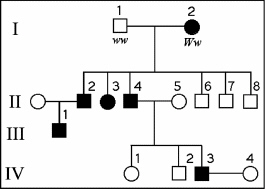
Figure 14.2
|
|
|
58.
|
What is the genotype of individual
II-5?
a. | WW | b. | Ww | c. | ww | d. | WW or
ww | e. | ww or
Ww |
|
|
|
59.
|
What is the likelihood that the progeny of IV-3 and
IV-4 will have wooly hair?
a. | 0% | b. | 25% | c. | 50% | d. | 75% | e. | 100% |
|
|
|
60.
|
What is the probability that individual III-1 is
Ww?
|
|
|
61.
|
People with sickle-cell trait
a. | are heterozygous for the sickle-cell
allele. | b. | are usually healthy. | c. | have increased resistance to malaria. | d. | produce normal and abnormal hemoglobin. | e. | All of the above |
|
|
|
62.
|
When a disease is said to have a multifactorial
basis, it means that
a. | both genetic and environmental factors contribute to the
disease. | b. | it is caused by a gene with a large number of
alleles. | c. | it affects a large number of
people. | d. | it has many different
symptoms. | e. | it tends to skip a
generation. |
|
|
|
63.
|
An ideal procedure for fetal testing in humans
would have which of the following features?
a. | Lowest risk procedure that would provide the most
reliable information | b. | The procedure that
can test for the greatest number of traits at once | c. | A procedure that provides a 3D image of the fetus | d. | The procedure that can be performed at the earliest time in the
pregnancy | e. | A procedure that could test for the carrier status of
the fetus |
|
|
|
64.
|
A scientist discovers a DNA-based test for the
allele of a particular gene. This and only this allele, if homozygous, produces an effect that
results in death at or about the time of birth. Of the following, which is the best use of this
discovery?
a. | To screen all newborns of an at-risk
population | b. | To design a test
for identifying heterozygous carriers of the allele | c. | To introduce a normal allele into deficient
newborns | d. | To follow the segregation of the allele during
meiosis | e. | To test school-age children for the
disorder |
|
|
|
65.
|
An obstetrician knows that one of her patients is a
pregnant woman whose fetus is at risk for a serious disorder that is detectable biochemically in
fetal cells. The obstetrician would most reasonably offer which of the following procedures to her
patient?
a. | CVS | b. | Ultrasound imaging | c. | Amniocentesis | d. | Fetoscopy | e. | X-ray |
|
|
|
66.
|
The frequency of heterozygosity for the sickle cell
anemia allele is unusually high, presumably because this reduces the frequency of malaria. Such a
relationship is related to which of the following?
a. | Mendel's law of independent
assortment | b. | Mendel's law
of segregation | c. | Darwin's
explanation of natural selection | d. | Darwin's
observations of competition | e. | The malarial
parasite changing the allele |
|
|
|
67.
|
Cystic fibrosis (CF) is a Mendelian disorder in the
human population that is inherited as a recessive. Two normal parents have two children with CF. The
probability of their next child being normal for this characteristic is which of the
following?
|
|
|
68.
|
Phenylketonuria (PKU) is a recessive human disorder
in which an individual cannot appropriately metabolize a particular amino acid. This amino acid is
not otherwise produced by humans. Therefore the most efficient and effective treatment is which of
the following?
a. | Feed them the substrate that can be metabolized into
this amino acid. | b. | Transfuse the
patients with blood from unaffected donors. | c. | Regulate the diet
of the affected persons to severely limit the uptake of the amino acid. | d. | Feed the patients the missing enzymes in a regular cycle, i.e., twice per
week. |
|
|
|
69.
|
Hutchinson-Gilford progeria is an exceedingly rare
human genetic disorder in which there is very early senility, and death, usually of coronary artery
disease, at an average age of approximately 13. Patients, who look very old even as children, do not
live to reproduce. Which of the following represents the most likely assumption?
a. | All cases must occur in relatives; therefore, there must
be only one mutant allele. | b. | Successive
generations of a family will continue to have more and more cases over
time. | c. | The disorder may be due to mutation in a single
protein-coding gene. | d. | Each patient will
have had at least one affected family member in a previous generation. | e. | The disease is autosomal dominant. |
|
|
|
70.
|
A pedigree analysis for a given disorder's
occurrence in a family shows that, although both parents of an affected child are normal, each of the
parents has had affected relatives with the same condition. The disorder is then which of the
following?
a. | Recessive | b. | Dominant | c. | Incompletely
dominant | d. | Maternally inherited | e. | A new mutation |
|
|
|
71.
|
One of two major forms of a human condition called
neurofibromatosis (NF 1) is inherited as a dominant, although it may be either mildly to very
severely expressed. If a young child is the first in her family to be diagnosed, which of the
following is the best explanation?
a. | The mother carries the gene but does not express it at
all. | b. | One of the parents has very mild expression of the
gene. | c. | The condition skipped a generation in the
family. | d. | The child has a different allele of the gene than the
parents. |
|
Matching
|
|
|
Match each term with the correct statement
below. a. | Gene | b. | Allele | c. | Character | d. | Trait | e. | Dominant
allele | f. | Recessive allele | g. | Genotype | h. | Phenotype | i. | Homozygous | j. | Heterozygous | k. | Testcross | l. | Monohybrid
cross |
|
|
|
72.
|
An organism’s appearance or observable
traits
|
|
|
73.
|
Determines phenotype in a
heterozygote
|
|
|
74.
|
A cross between an individual with an unknown
genotype and homozygous recessive individual
|
|
|
75.
|
Having two identical alleles for a
gene
|
|
|
76.
|
The genetic makeup of an individual
|
|
|
77.
|
An alternative version of a gene
|
|
|
78.
|
Has no effect on phenotype in a
heterozygote
|
|
|
79.
|
A variant for a character
|
|
|
80.
|
Having two different alleles for a
gene
|
|
|
81.
|
A heritable unit that determines a character and
can exist in different forms.
|
|
|
82.
|
A cross between individuals heterozygous for a
single character
|
|
|
83.
|
A heritable feature that varies among
individuals
|
Short Answer
|
|
|
84.
|
Two pea plants heterozygous for the characters of
pod color and pod shape are crossed. Draw a Punnett square to determine the phenotypic ratios of the
offspring.
|
|
|
85.
|
In some plants, a true-breeding, red-flowered
strain gives all pink flowers when crossed with a white-flowered strain:  (red) ´ (red) ´  (white) ® (white) ®  (pink). If flower position (axial or
terminal) is inherited as it is in peas (see Table 14.1 in your textbook), what will be the ratios of
genotypes and phenotypes of the (pink). If flower position (axial or
terminal) is inherited as it is in peas (see Table 14.1 in your textbook), what will be the ratios of
genotypes and phenotypes of the  generation resulting from the following
cross: axial-red (true-breeding) ´ terminal-white? What will be the
ratios in the generation resulting from the following
cross: axial-red (true-breeding) ´ terminal-white? What will be the
ratios in the  generation? generation?
|
|
|
86.
|
Flower position, stem length, and seed shape were
three characters that Mendel studied. Each is controlled by an independently assorting gene and has
dominant and recessive expression as follows:
| Character | Dominant | Recessive | | Flower position | Axial (A) | Terminal (a) | | Stem length | Tall (T) | Dwarf (t) | | Seed shape | Round (R) | Wrinkled (r) | | | |
If a plant that is heterozygous for all three characters is allowed to
self-fertilize, what proportion of the offspring would you expect to be as follows? (Note: Use the
rules of probability instead of a huge Punnett square.)
A) Homozygous for the three dominant
traits
B) Homozygous for the three recessive traits
C) Heterozygous for all three
characters
D) Homozygous for axial and tall, heterozygous for seed shape
|
|
|
87.
|
A black guinea pig crossed with an albino guinea
pig produces 12 black offspring. When the albino is crossed with a second black one, 7 blacks and 5
albinos are obtained. What is the best explanation for this genetic situation? Write genotypes for
the parents, gametes, and offspring.
|
|
|
88.
|
In sesame plants, the one-pod condition (P)
is dominant to the three-pod condition (p), and normal leaf (L) is dominant to wrinkled
leaf (l). Pod type and leaf type are inherited independently. Determine the genotypes for the
two parents for all possible matings producing the following offspring:
A) 318 one-pod, normal
leaf and 98 one-pod, wrinkled leaf
B) 323 three-pod, normal leaf and 106 three-pod, wrinkled
leaf
C) 401 one-pod, normal leaf
D) 150 one-pod, normal leaf, 147 one-pod, wrinkled leaf, 51
three-pod, normal leaf, and 48 three-pod, wrinkled leaf
E) 223 one-pod, normal leaf, 72 one-pod,
wrinkled leaf, 76 three-pod, normal leaf, and 27 three-pod, wrinkled leaf
|
|
|
89.
|
A man with type A blood marries a woman with type B
blood. Their child has type O blood. What are the genotypes of these individuals? What other
genotypes, and in what frequencies, would you expect in offspring from this marriage?
|
|
|
90.
|
Phenylketonuria (PKU) is an inherited disease
caused by a recessive allele. If a woman and her husband, who are both carriers, have three children,
what is the probability of each of the following?
A) All three children are of normal
phenotype.
B) One or more of the three children have the disease.
C) All three children have
the disease.
D) At least one child is phenotypically normal.
(Note: Remember that the
probabilities of all possible outcomes always add up to 1.)
|
|
|
91.
|
The genotype of  individuals
in a tetrahybrid cross is AaBbCcDd. Assuming independent assortment of these four genes, what
are the probabilities that individuals
in a tetrahybrid cross is AaBbCcDd. Assuming independent assortment of these four genes, what
are the probabilities that  offspring will have the following
genotypes? offspring will have the following
genotypes?
A) aabbccdd
B) AaBbCcDd
C) AABBCCDD
D)
AaBBccDd
E) AaBBCCdd
|
|
|
92.
|
What is the probability that each of the following
pairs of parents will produce the indicated offspring? (Assume independent assortment of all gene
pairs.)
A) AABBCC ´ aabbcc ® AaBbCc
B) AABbCc ´
AaBbCc ® AAbbCC
C) AaBbCc ´ AaBbCc ® AaBbCc
D)
aaBbCC ´ AABbcc ®
AaBbCc
|
|
|
93.
|
Karen and Steve each have a sibling with
sickle-cell disease. Neither Karen nor Steve nor any of their parents have the disease, and none of
them have been tested to reveal sickle-cell trait. Based on this incomplete information, calculate
the probability that if this couple has a child, the child will have sickle-cell
disease.
|
|
|
94.
|
In 1981, a stray black cat with unusual rounded,
curled-back ears was adopted by a family in California. Hundreds of descendants of the cat have since
been born, and cat fanciers hope to develop the curl cat into a show breed. Suppose you owned the
first curl cat and wanted to develop a true-breeding variety. How would you determine whether the
curl allele is dominant or recessive? How would you obtain true-breeding curl cats? How could you be
sure they are true-breeding?
|
|
|
95.
|
Imagine that a newly discovered, recessively
inherited disease is expressed only in individuals with type O blood, although the disease and blood
group are independently inherited. A normal man with type A blood and a normal woman with type B
blood have already had one child with the disease. The woman is now pregnant for a second time. What
is the probability that the second child will also have the disease? Assume that both parents are
heterozygous for the gene that causes the disease.
|
|
|
96.
|
In tigers, a recessive allele causes an absence of
fur pigmentation (a white tiger) and a cross-eyed condition. If two phenotypically normal tigers that
are heterozygous at this locus are mated, what percentage of their offspring will be cross-eyed? What
percentage will be white?
|
|
|
97.
|
In corn plants, a dominant allele I inhibits
kernel color, while the recessive allele i permits color when homozygous. At a different
locus, the dominant allele P causes purple kernel color, while the homozygous recessive
genotype pp causes red kernels. If plants heterozygous at both loci are crossed, what will be
the phenotypic ratio of the offspring?
|
|
|
98.
|
The pedigree below traces the inheritance of
alkaptonuria, a biochemical disorder. Affected individuals, indicated here by the colored circles and
squares, are unable to metabolize a substance called alkapton, which colors the urine and stains body
tissues. Does alkaptonuria appear to be caused by a dominant allele or by a recessive allele? Fill in
the genotypes of the individuals whose genotypes can be deduced. What genotypes are possible for each
of the other individuals?
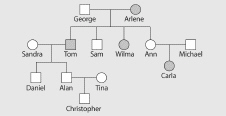
|
|
|
99.
|
A man has six fingers on each hand and six toes on
each foot. His wife and their daughter have the normal number of digits. Extra digits is a dominant
trait. What fraction of this couple's children would be expected to have extra
digits?
|
|
|
100.
|
Imagine that you are a genetic counselor, and a
couple planning to start a family comes to you for information. Charles was married once before, and
he and his first wife had a child with cystic fibrosis. The brother of his current wife, Elaine, died
of cystic fibrosis. What is the probability that Charles and Elaine will have a baby with cystic
fibrosis? (Neither Charles nor Elaine has cystic fibrosis.)
|
|
|
101.
|
In mice, black color (B) is dominant to
white (b). At a different locus, a dominant allele (A) produces a band of yellow just
below the tip of each hair in mice with black fur. This gives a frosted appearance known as agouti.
Expression of the recessive allele (a) results in a solid coat color. If mice that are
heterozygous at both loci are crossed, what is the expected phenotypic ratio of their
offspring?
|