Multiple Choice
Identify the
choice that best completes the statement or answers the question.
|
|
|
1.
|
In a single molecule of water, two hydrogen atoms
are bonded to a single oxygen atom by
a. | hydrogen bonds. | b. | nonpolar covalent bonds. | c. | polar covalent
bonds. | d. | ionic bonds. | e. | van der Waals interactions. |
|
|
|
2.
|
The slight negative charge at one end of one water
molecule is attracted to the slight positive charge of another water molecule. What is this
attraction called?
a. | a covalent bond | b. | a hydrogen bond | c. | an ionic
bond | d. | a hydrophilic bond | e. | a hydrophobic bond |
|
|
|
3.
|
An example of a hydrogen bond is the bond
between
a. | C and H in methane (CH ). ). | b. | the H of one water
molecule and the O of another water molecule. | c. | Na and Cl and Cl in salt. in salt. | d. | the two hydrogen atoms in a molecule of hydrogen gas (H ). ). | e. | Mg and Cl and Cl in MgCl in MgCl . . |
|
|
|
4.
|
Water is able to form hydrogen bonds
because
a. | oxygen has a valence of 2. | b. | the water molecule is shaped like a tetrahedron. | c. | the bonds that hold together the atoms in a water molecule are polar covalent
bonds. | d. | the oxygen atom in a water molecule has a weak positive
charge. | e. | each of the hydrogen atoms in a water molecule is weakly
negative in charge. |
|
|
|
5.
|
What gives rise to the cohesiveness of water
molecules?
a. | hydrophobic interactions | b. | nonpolar covalent bonds | c. | ionic
bonds | d. | hydrogen bonds | e. | both A and C |
|
|
|
6.
|
Which of the following effects is produced by the
high surface tension of water?
a. | Lakes don't freeze solid in winter, despite low
temperatures. | b. | A water strider
can walk across the surface of a small pond. | c. | Organisms resist
temperature changes, although they give off heat due to chemical reactions. D) Water can act as a
solvent. | d. | The pH of water remains exactly
neutral. |
|
|
|
7.
|
Which of the following takes place as an ice cube
cools a drink?
a. | Molecular collisions in the drink
increase. | b. | Kinetic energy in the drink
decreases. | c. | A calorie of heat
energy is transferred from the ice to the water of the drink. | d. | The specific heat of the water in the drink
decreases. | e. | Evaporation of the
water in the drink increases. |
|
|
|
8.
|
Which of the following statements correctly defines
a kilocalorie?
a. | the amount of heat required to raise the temperature of
1 g of water by 1°F | b. | the amount of heat
required to raise the temperature of 1 g of water by 1°C | c. | the amount of heat required to raise the temperature of 1 kg of water by
1°F | d. | the amount of heat required to raise the temperature of
1 kg of water by 1°C | e. | the amount of heat
required to raise the temperature of 1,000 g of water by
1°F |
|
|
|
9.
|
The nutritional information on a cereal box shows
that one serving of a dry cereal has 200 kilocalories. If one were to burn one serving of the cereal,
the amount of heat given off would be sufficient to raise the temperature of 20 kg of water how many
degrees Celsius?
a. | 0.2°C | b. | 1.0°C | c. | 2.0°C | d. | 10.0°C | e. | 20.0°C |
|
|
|
10.
|
Water's high specific heat is mainly a
consequence of the
a. | small size of the water
molecules. | b. | high specific heat
of oxygen and hydrogen atoms. | c. | absorption and
release of heat when hydrogen bonds break and form. | d. | fact that water is a poor heat conductor. | e. | inability of water to dissipate heat into dry
air. |
|
|
|
11.
|
Which type of bond must be broken for water to
vaporize?
a. | ionic bonds | b. | nonpolar covalent bonds | c. | polar covalent
bonds | d. | hydrogen bonds | e. | covalent bonds |
|
|
|
12.
|
Temperature usually increases when water condenses.
Which behavior of water is most directly responsible for this phenomenon?
a. | the change in density when it condenses to form a liquid
or solid | b. | reactions with other atmospheric
compounds | c. | the release of heat by the formation of hydrogen
bonds | d. | the release of heat by the breaking of hydrogen
bonds | e. | the high surface tension of
water |
|
|
|
13.
|
At what temperature is water at its
densest?
a. | 0°C | b. | 4°C | c. | 32°C | d. | 100°C | e. | 212°C |
|
|
|
14.
|
Why does ice float in liquid water?
a. | The liquid water molecules have more kinetic energy and
thus support the ice. | b. | The ionic bonds
between the molecules in ice prevent the ice from sinking. | c. | Ice always has air bubbles that keep it afloat. | d. | Hydrogen bonds stabilize and keep the molecules of ice farther apart than the
water molecules of liquid water. | e. | The crystalline
lattice of ice causes it to be denser than liquid water. |
|
|
|
15.
|
The following question is based on Figure 3.1:
solute molecule surrounded by a hydration shell of water.
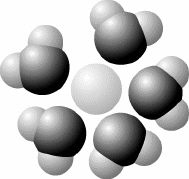
Figure 3.1
Based on your knowledge of the polarity of water molecules,
the solute molecule is most likely
a. | positively charged. | b. | negatively charged. | c. | without
charge. | d. | hydrophobic. | e. | nonpolar. |
|
|
|
16.
|
Hydrophobic substances such as vegetable oil
are
a. | nonpolar substances that repel water
molecules. | b. | nonpolar
substances that have an attraction for water molecules. | c. | polar substances that repel water molecules. | d. | polar substances that have an affinity for water. | e. | charged molecules that hydrogen-bond with water
molecules. |
|
|
|
17.
|
One mole (mol) of a substance is
a. | 6.02 ´ 10 molecules of the substance.
 | b. | 1 g of the
substance dissolved in 1 L of solution. | c. | the largest amount
of the substance that can be dissolved in 1 L of solution. | d. | the molecular mass of the substance expressed in
grams. | e. | A and D only |
|
|
|
18.
|
How many molecules of glucose ( molecular mass =180 daltons) would be present in one mole of glucose?
a. | 24 | b. | 342 | c. | 23 ´ 1014 | d. | 180 ´ 1014 | e. | 6.02 ´ 1023 |
|
|
|
19.
|
How many molecules of glycerol ( )
would be present in 1 L of a 1 M glycerol solution? )
would be present in 1 L of a 1 M glycerol solution?
a. | 1 | b. | 14 | c. | 92 | d. | 1 ´ 10 | e. | 6.02 ´ 10 |
|
|
|
20.
|
When an ionic compound such as sodium chloride
(NaCl) is placed in water the component atoms of the NaCl crystal dissociate into individual sodium
ions (Na ) and chloride ions (Cl ) and chloride ions (Cl ). In contrast, the atoms of covalently bonded molecules (e.g., glucose, sucrose,
glycerol) do not generally dissociate when placed in aqueous solution. Which of the following
solutions would be expected to contain the greatest number of particles (molecules or
ions)? ). In contrast, the atoms of covalently bonded molecules (e.g., glucose, sucrose,
glycerol) do not generally dissociate when placed in aqueous solution. Which of the following
solutions would be expected to contain the greatest number of particles (molecules or
ions)?
a. | 1 L of 0.5 M NaCl | b. | 1 L of 0.5 M glucose | c. | 1 L of 1.0 M NaCl | d. | 1 L of 1.0
M glucose | e. | C and D will
contain equal numbers of particles. |
|
|
|
21.
|
The molar mass of glucose is 180 g/mol. Which of
the following procedures should you carry out to make a 1 M solution of glucose?
a. | Dissolve 1 g of glucose in 1 L of
water. | b. | Dissolve 180 g of glucose in 1 L of
water. | c. | Dissolve 180 g of glucose in 100 g of
water. | d. | Dissolve 180 mg (milligrams) of glucose in 1 L of
water. | e. | Dissolve 180 g of glucose in water, and then add more
water until the total volume of the solution is 1 L. |
|
|
|
22.
|
The molar mass of glucose ( )
is 180 g/mol. Which of the following procedures should you carry out to make a 0.5 M solution
of glucose? )
is 180 g/mol. Which of the following procedures should you carry out to make a 0.5 M solution
of glucose?
a. | Dissolve 0.5 g of glucose in a small volume of water,
and then add more water until the total volume of solution is 1 L. | b. | Dissolve 90 g of glucose in a small volume of water, and then add more water
until the total volume of the solution is 1 L. | c. | Dissolve 180 g of
glucose in a small volume of water, and then add more water until the total volume of the solution is
1 L. | d. | Dissolve 0.5 g of glucose in 1 L of
water. | e. | Dissolve 180 g of glucose in 1 L of
water. |
|
|
|
|
|
|
23.
|
How many grams of the molecule in Figure 3.2 would
be equal to 1 mol of the molecule?
(Carbon = 12, Oxygen = 16, Hydrogen = 1)
|
|
|
24.
|
How many grams would be equal to 1 mol of the
compound shown in Figure 3.2?
(Carbon = 12, Oxygen = 16, Hydrogen = 1)
|
|
|
25.
|
How many grams of the compound in Figure 3.2 would
be required to make 2.5 L of a 1 M solution?
(Carbon = 12, Oxygen = 16, Hydrogen =
1)
|
|
|
26.
|
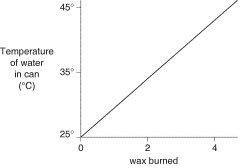
A small birthday candle is weighed, then lighted
and placed beneath a metal can containing 100 mL of water. Careful records are kept as the
temperature of the water rises. Data from this experiment are shown on the graph. What amount of heat
energy is released in the burning of candle wax?
a. | 0.5 kilocalories per gram of wax
burned | b. | 5 kilocalories per gram of wax
burned | c. | 10 kilocalories per gram of wax
burned | d. | 20 kilocalories per gram of wax
burned | e. | 50 kilocalories per gram of wax
burned |
|
|
|
27.
|
Identical heat lamps are arranged to shine on
identical containers of water and methanol (wood alcohol), so that each liquid absorbs the same
amount of energy minute by minute. The covalent bonds of methanol molecules are non-polar, so there
are no hydrogen bonds among methanol molecules. Which of the following graphs correctly describes
what will happen to the temperature of the water and the methanol?
|
|
|
28.
|
You have a freshly prepared 0.1M solution of
glucose in water. Each liter of this solution contains how many glucose molecules?
a. | 6.02 ´ 10 | b. | 3.01 ´ 10 | c. | 6.02 ´ 10 | d. | 12.04 ´ 10 | e. | 6.02 ´ 10 |
|
|
|
29.
|
The molecular weight of water is 18 daltons. What
is the molarity of 1 liter of pure water?
a. | 55.6M | b. | 18M | c. | 37M | d. | 0.66M | e. | 1.0M |
|
|
|
30.
|
You have a freshly-prepared 1M solution of glucose
in water. You carefully pour out a 100 mL sample of that solution. How many glucose molecules are
included in that 100 mL sample?
a. | 6.02 ´ 10 | b. | 3.01 ´ 10 | c. | 6.02 ´ 10 | d. | 12.04 ´ 10 | e. | 6.02 ´ 10 |
|
|
|
31.
|
Which of the following ionizes completely in
solution and is considered to be a strong acid?
a. | NaOH | b. | HCl | c. | NH | d. | H CO CO | e. | CH COOH COOH |
|
|
|
32.
|
Which of the following ionizes completely in
solution and is considered to be a strong base (alkali)?
a. | NaCl | b. | HCl | c. | NH | d. | H CO CO | e. | NaOH |
|
|
|
33.
|
Which of the following statements is
completely correct?
|
|
|
34.
|
A given solution contains 0.0001(10 )
moles of hydrogen ions [H )
moles of hydrogen ions [H ] per liter. Which of the following best
describes this solution? ] per liter. Which of the following best
describes this solution?
a. | acidic: H acceptor
 | b. | basic: H acceptor
 | c. | acidic: H donor
donor | d. | basic: H donor
donor | e. | neutral |
|
|
|
35.
|
A solution contains 0.0000001(10 )
moles of hydroxyl ions [OH )
moles of hydroxyl ions [OH ] per liter. Which of the following best
describes this solution? ] per liter. Which of the following best
describes this solution?
a. | acidic: H acceptor
 | b. | basic: H acceptor
 | c. | acidic: H donor
donor | d. | basic: H donor
donor | e. | neutral |
|
|
|
36.
|
What is the pH of a solution with a hydroxyl ion
[OH ] concentration of 10 ] concentration of 10 M?
M?
a. | pH 2 | b. | pH 4 | c. | pH
10 | d. | pH 12 | e. | pH 14 |
|
|
|
37.
|
What is the pH of a solution with a hydrogen ion
[H ] concentration of 10 ] concentration of 10 M?
M?
a. | pH 2 | b. | pH 4 | c. | pH
6 | d. | pH 8 | e. | pH 10 |
|
|
|
38.
|
Which of the following solutions has the greatest
concentration of hydrogen ions [H ]? ]?
a. | gastric juice at pH 2 | b. | vinegar at pH 3 | c. | tomato juice at pH
4 | d. | black coffee at pH 5 | e. | household bleach at pH 12 |
|
|
|
39.
|
Which of the following solutions has the greatest
concentration of hydroxyl ions [OH ]? ]?
a. | lemon juice at pH 2 | b. | vinegar at pH 3 | c. | tomato juice at pH
4 | d. | urine at pH 6 | e. | seawater at pH 8 |
|
|
|
40.
|
If the pH of a solution is decreased from 9 to 8,
it means that the
a. | concentration of H has
decreased to one-tenth (1/10) what it was at pH 9. has
decreased to one-tenth (1/10) what it was at pH 9. | b. | concentration of H has increased 10-fold (10X) compared to what
it was at pH 9. has increased 10-fold (10X) compared to what
it was at pH 9. | c. | concentration of
OH has increased 10-fold (10X) compared to what
it was at pH 9. has increased 10-fold (10X) compared to what
it was at pH 9. | d. | concentration of
OH has decreased to one-tenth (1/10) what it was
at pH 9. has decreased to one-tenth (1/10) what it was
at pH 9. | e. | Both B and D are
correct. |
|
|
|
41.
|
If the pH of a solution is increased from pH 5 to
pH 7, it means that the
a. | concentration of H is twice
(2X) what it was at pH 5. is twice
(2X) what it was at pH 5. | b. | concentration of
H is half (1/2) what it was at pH
5. is half (1/2) what it was at pH
5. | c. | concentration of OH is 100 times
greater than what it was at pH 5. is 100 times
greater than what it was at pH 5. | d. | concentration of
OH is one-hundredth (0.01X) what it was at pH
5. is one-hundredth (0.01X) what it was at pH
5. | e. | concentration of H is 100 times
greater and the concentration of OH is 100 times
greater and the concentration of OH is one-hundredth what they were at pH
5. is one-hundredth what they were at pH
5. |
|
|
|
42.
|
One liter of a solution of pH 2 has how many more
hydrogen ions (H ) than 1 L of a solution of pH
6? ) than 1 L of a solution of pH
6?
a. | 4 times more | b. | 400 times more | c. | 4,000 times
more | d. | 10,000 times more | e. | 100,000 times more |
|
|
|
43.
|
One liter of a solution pH 9 has how many more
hydroxyl ions (OH ) than 1 L of a solution of pH
4? ) than 1 L of a solution of pH
4?
a. | 5 times more | b. | 100 times more | c. | 1,000 times
more | d. | 10,000 times more | e. | 100,000 times more |
|
|
|
44.
|
Which of the following statements is true
about buffer solutions?
a. | They maintain a constant pH when bases are added to them
but not when acids are added to them. | b. | They maintain a
constant pH when acids are added to them but not when bases are added to
them. | c. | They maintain a constant pH of exactly 7 in all living
cells and biological fluids. | d. | They maintain a
relatively constant pH when either acids or bases are added to them. | e. | They are found only in living systems and biological
fluids. |
|
|
|
45.
|
Buffers are substances that help resist shifts in
pH by
a. | releasing H in acidic
solutions. in acidic
solutions. | b. | donating H to a solution when they have been depleted. to a solution when they have been depleted. | c. | releasing OH in basic
solutions. in basic
solutions. | d. | accepting H when the are in excess. when the are in excess. | e. | Both B and D are
correct. |
|
|
|
46.
|
One of the buffers that contribute to pH stability
in human blood is carbonic acid ( ). Carbonic acid is a weak acid that
dissociates into a bicarbonate ion ( ). Carbonic acid is a weak acid that
dissociates into a bicarbonate ion ( ) and a hydrogen ion (H ) and a hydrogen ion (H ). Thus, ). Thus,
If the pH of the blood drops, one would
expect
|
|
|
47.
|
One of the buffers that contribute to pH stability
in human blood is carbonic acid  . Carbonic acid is a weak acid that when
placed in an aqueous solution dissociates into a bicarbonate ion (HCO . Carbonic acid is a weak acid that when
placed in an aqueous solution dissociates into a bicarbonate ion (HCO ) and a
hydrogen ion (H ) and a
hydrogen ion (H ). Thus, ). Thus,
If the pH of the blood increases, one would expect
|
|
|
48.
|
Assume that acid rain has lowered the pH of a
particular lake to pH 4.0. What is the hydroxyl ion concentration of this lake?
a. | 1 ´ 10 mol of hydroxyl ion per liter of lake water
 | b. | 1 ´ 10 mol of hydroxyl ion per liter of lake
water mol of hydroxyl ion per liter of lake
water | c. | 10.0 M with regard to hydroxyl ion
concentration | d. | 4.0 M with
regard to hydroxyl ion concentration | e. | both B and
D |
|
|
|
49.
|
Research indicates that acid precipitation can
damage living organisms by
a. | buffering aquatic systems such as lakes and
streams. | b. | decreasing the H concentration of lakes and streams.
 | c. | increasing the
OH concentration of lakes and
streams. concentration of lakes and
streams. | d. | washing away certain mineral ions that help buffer soil
solution and are essential nutrients for plant growth. | e. | both B and C |
|
|
|
50.
|
Consider two solutions: solution X has a pH of 4;
solution Y has a pH of 7. From this information, we can reasonably conclude that
a. | solution Y has no free hydrogen ions (H ). ). | b. | the concentration
of hydrogen ions in solution X is 30 times as great as the concentration of hydrogen ions in solution
Y. | c. | the concentration of hydrogen ions in solution Y is
1,000 times as great as the concentration of hydrogen ions in solution X. | d. | the concentration of hydrogen ions in solution X is 3 times as great as the
concentration of hydrogen ions in solution Y. | e. | None of the other
answer choices correctly describes these solutions. |
|
|
|
51.
|
Pure, freshly-distilled water has a pH of 7. This
means that
|
|
|
52.
|
Carbon dioxide ( ) is readily
soluble in water, according to the equation ) is readily
soluble in water, according to the equation  Carbonic acid ( Carbonic acid ( ) is a weak acid. If ) is a weak acid. If  is bubbled into a beaker containing pure,
freshly-distilled water, which of the following graphs correctly describes the results? is bubbled into a beaker containing pure,
freshly-distilled water, which of the following graphs correctly describes the results?
|
|
|
53.
|
Carbon dioxide (CO ) is readily
soluble in water, according to the equation CO ) is readily
soluble in water, according to the equation CO + H + H O O
 H H CO CO . Carbonic
acid (H . Carbonic
acid (H CO CO ) is a weak acid. Respiring
cells release CO ) is a weak acid. Respiring
cells release CO . What prediction can we make about the pH of
blood as that blood first comes in contact with respiring cells? . What prediction can we make about the pH of
blood as that blood first comes in contact with respiring cells?
a. | Blood pH will decrease
slightly. | b. | Blood pH will increase
slightly. | c. | Blood pH will remain
unchanged. | d. | Blood pH will
first increase, then decrease as CO combines with
hemoglobin. combines with
hemoglobin. | e. | Blood pH will
first decrease, then increase sharply as CO combines with
hemoglobin. combines with
hemoglobin. |
|
|
|
54.
|
A 100 mL beaker contains 10 mL of NaOH solution at
pH = 13. A technician carefully pours into the beaker, 10 mL of HCl at pH = 1. Which of the following
statements correctly describes the results of this mixing?
a. | The concentration of Na ion
rises. ion
rises. | b. | The concentration of Cl ion
falls. ion
falls. | c. | The concentration of undissociated H O
molecules remains unchanged. O
molecules remains unchanged. | d. | The pH of the
beaker's contents rises. | e. | The pH of the
beaker's contents falls. |
|
|
|
55.
|
Equal volumes of vinegar from a freshly-opened
bottle are added to each of the following solutions. After complete mixing, which of the mixtures
will have the highest pH?
a. | 100 mL of pure water | b. | 100 mL of freshly-brewed coffee | c. | 100 mL of household cleanser containing 0.5M
ammonia | d. | 100 mL of freshly-squeezed orange
juice | e. | 100 mL of tomato
juice |
|
|
|
56.
|
You have two beakers; one contains pure water, the
other contains pure methanol (wood alcohol). The covalent bonds of methanol molecules are nonpolar,
so there are no hydrogen bonds among methanol molecules. You pour crystals of table salt (NaCl) into
each beaker. Predict what will happen.
a. | Equal amounts of NaCl crystals will dissolve in both
water and methanol. | b. | NaCl crystals will
NOT dissolve in either water or methanol. | c. | NaCl crystals will
dissolve readily in water but will not dissolve in methanol. | d. | NaCl crystals will dissolve readily in methanol but will not dissolve in
water. | e. | When the first crystals of NaCl are added to water or to
methanol, they will not dissolve; but as more crystals are added, the crystals will begin to dissolve
faster and faster. |
|
|
|
57.
|
You have two beakers. One contains a solution of
HCl at pH = 1.0. The other contains a solution of NaOH at pH = 13. Into a third beaker, you slowly
and cautiously pour 20 mL of the HCL and 20 mL of the NaOH. After complete stirring, the pH of the
mixture will be
a. | 2.0. | b. | 12.0. | c. | 7.0. | d. | 5.0. | e. | 9.0. |
|
|
|
Self-Quiz Questions
|
|
|
58.
|
Many mammals control their body temperature by
sweating. Which property of water is most directly responsible for the ability of sweat to lower body
temperature?
a. | water's change in density when it
condenses | b. | water's ability to dissolve molecules in the
air | c. | the release of heat by the formation of hydrogen
bonds | d. | the absorption of heat by the breaking of hydrogen
bonds | e. | water's high surface
tension |
|
|
|
59.
|
A slice of pizza has 500 kcal. If we could burn the
pizza and use all the heat to warm a 50-L container of cold water, what would be the approximate
increase in the temperature of the water? (Note: A liter of cold water weighs about 1
kg.)
a. | 50°C | b. | 5°C | c. | 10°C | d. | 100°C | e. | 1°C |
|
|
|
60.
|
The bonds that are broken when water vaporizes
are
a. | ionic bonds. | b. | hydrogen bonds between water molecules. | c. | covalent bonds between atoms within water
molecules. | d. | polar covalent
bonds. | e. | nonpolar covalent
bonds |
|
|
|
61.
|
Which of the following is a hydrophobic
material?
a. | paper | b. | table salt | c. | wax | d. | sugar | e. | pasta |
|
|
|
62.
|
We can be sure that a mole of table sugar and a
mole of vitamin C are equal in their
a. | mass in daltons. | b. | mass in grams. | c. | number of
molecules. | d. | number of
atoms. | e. | volume. |
|
|
|
63.
|
How many grams of acetic acid
(C2H4O2) would you use to make 10 L of a 0.1 M aqueous
solution of acetic acid? (Note: The atomic masses, in daltons, are approximately 12 for
carbon, 1 for hydrogen, and 16 for oxygen.)
a. | 10.0 g | b. | 0.1 g | c. | 6.0
g | d. | 60.0 g | e. | 0.6 g |
|
|
|
64.
|
Measurements show that the pH of a particular lake
is 4.0. What is the hydrogen ion concentration of the lake?
a. | 4.0 M | b. | 10 M M | c. | 10 M M | d. | 10 M M | e. | 4% |
|
|
|
65.
|
What is the hydroxide ion concentration of
the lake described in question 7?
a. | 10 M
M | b. | 10 M
M | c. | 10 M
M | d. | 10 M
M | e. | 10 M |
|
Short Answer
|
|
|
66.
|
Draw three water molecules and label the atoms.
Draw solid lines to indicate covalent bonds and dotted lines for hydrogen bonds. Add partial charge
labels as appropriate.
|